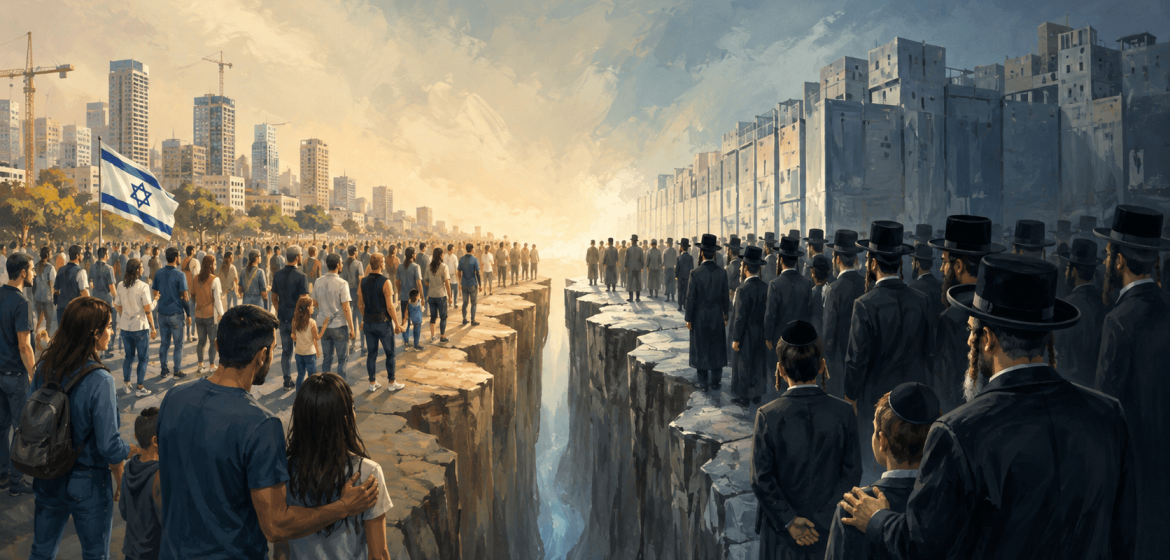

About a month ago, I spoke with an older and wise friend, a man with many years of experience in public affairs, much of it behind the scenes of Israeli policymaking. He is a public-policy professional, religious and God-fearing, sympathetic to Haredim, and works with Haredim all the time. He can hardly be suspected of animosity toward us.
When the conversation turned to Haredim and the state, I said to him, painfully: “Unless something dramatic happens, the State of Israel will collapse in ten or twenty years because of this issue.”
He responded with a sentence I did not expect: “The State of Israel will survive. The question is what will happen to you—to Haredi society.”
It took me several hours to process what he had said before realizing that he was probably right.
Defensive Democracy: From the Courtroom to the Street
The term “defensive democracy” was coined by Karl Loewenstein in two 1937 essays written against the background of the collapse of the Weimar Republic. It expresses a basic principle: a democracy may defend itself against those who exploit its own institutions in order to destroy it.[1] In Israel, the principle is enshrined in Basic Law: The Knesset, which permits the disqualification of a political list—denying it the fundamental right to participate in elections—if it rejects Israel’s existence as a Jewish state or its democratic character. Its Israeli roots go back to the 1965 Yardor case, in which Justice Zussman reasoned that just as a person need not consent to being killed, “a state need not agree to be destroyed.”[2]
That is the legal, orderly version. There is a defined basis for action; the decision must pass through a transparent committee process; and it is subject to judicial review. We have seen plenty of that version in recent years.
But the more common—and more dangerous—version now emerging is something else entirely. Most of the measures currently being taken against Haredi society belong to what might be called “defensive democracy, jungle edition.” Ever since Tocqueville and John Stuart Mill, the professional name for it has been the “tyranny of the majority”—in this case, exercised through budgets and administration.[3]
There is no written cause, no orderly procedure, no proportionality test, no single address against which to appeal. Instead, there is a majority that feels threatened and demands the use of every instrument available to it: budgets, regulation, enforcement, aggressive media discourse, pointed and hostile rhetoric in political campaigns, and the now-familiar expectation that every politician present a “plan for educating Haredi society.” An atmosphere takes hold in which anyone who possesses power acts according to his own conception of what must be done to defend society against the Haredim.
And here lies the critical difference. When the state disqualifies an electoral list, one can appeal. The same is true when the state decides to stop transferring money. But how does one appeal against an atmosphere that has spread across the majority population—when members of that majority are also the policymakers, both elected officials and civil servants, throughout the entire machinery of national and local government?
We should make no mistake: most Israelis are not on the Haredi side today. Some are motivated by hostility; others by frustration. But almost nobody—not even most traditional or Religious Zionist Israelis—understands us.
Do not take comfort in the relative quiet that their politicians tried to maintain. They played the game because they wanted a governing coalition. But even that game has run its course. If they want to remain in power, they will increasingly have to distance themselves from us. Their voters are already making that clear.
Go out and speak to people. On the street, things are approaching the boiling point. People who three years ago would have lowered their heads to receive a blessing from a Haredi rabbi now turn their heads away—and find other rabbis instead.
“What Have We Done to You?”
About five years ago, long before the draft issue exploded, I heard several Haredi friends involved in public affairs say that they simply did not understand why people were so angry with us.
I approached a non-Haredi friend—educated, thoughtful and serious—and asked him as plainly as I could: What have we done to you?
He took the question seriously. He asked me to gather my friends and then spent an hour and a half presenting us with data in an orderly presentation.
Demographically, he said, Haredim and Arabs are both growing relative to Zionist Israeli society. Both populations, in different ways, challenge the continued viability of the state. Arabs challenge its Zionist character, and some also challenge its security—but not its economy. Haredim, he argued, challenge its security in a different sense, the cohesion between the different parts of the nation, and above all liberalism—which, for a secular Israeli, is the basis of everything he considers essential to a free life. And Haredim challenge the economy. If the economy collapses, there will ultimately be neither security nor a state.
I am not discussing whether he was right. That is not my point.
What mattered was the fear.
We saw before us the fears of a man who genuinely worried that his children might one day have no country in which to live because of us. To understand his perspective, and that of many others who feel the same way, consider a few basic statistics.
Haredi society now constitutes 14.3 percent of Israel’s population—roughly one and a half million people—with a fertility rate of approximately 6.5 children per woman, among the highest in the developed world.[4] According to current projections—of course, these are subject to significant adjustments over time—our share of the population is expected to reach some 20–22 percent by 2065.[5]
When a rapidly growing group is perceived by the majority as a burden, demography ceases to be a statistic. It becomes a threat.
And that fear is measurable. According to the Jewish People Policy Institute’s 2026 Israeli Society Index, 55 percent of Israelis view internal polarization as the greatest threat to the state’s continued existence—far ahead of the Iranian nuclear threat, at 23 percent, or the Palestinian conflict, at 18 percent. Sixty percent believe there is a genuine danger of internal physical violence. Most strikingly, secular Israelis rank their sense of closeness to Haredim at just 1.81 out of 10—lower than their sense of closeness to Arabs, which stands at 4.28.[6]
In other words, to the average secular Israeli, we are more distant than the Arab minority.
And “distant” very quickly becomes “threatening.” Distance breeds alienation.[7]
The confrontation we are now beginning to recognize did not begin today, and in most cases it is not even being conducted according to some deliberate master plan. But there is an escalation ladder, and we should learn to recognize its stages.
A reform that raises teachers’ salaries or expands educational services—such as Ofek Hadash or GEFEN—while leaving Haredim outside is a mild symptom. The increasingly systematic freezing of Finance Ministry transfers to Haredi projects is already a defensive measure. Blocking Section 46 tax status for nonprofit organizations is likewise defensive. The Supreme Court ruling denying yeshiva funding for students legally required to enlist—a cut estimated at NIS 650 million annually[8]—marks a further escalation. Excluding draft-eligible men from subsidized housing begins to resemble open confrontation. Arresting them at the airport is already war in the full sense of the word.
We may only now be waking up. But this process has been developing for decades, ever since Israeli society realized that we were no longer a small and disappearing minority; ever since it became clear that 400 yeshiva exemptions were not a number destined to shrink, as people once assumed, but the beginning of something that would grow dramatically.[9]
And it is worth understanding what those original 400 exemptions actually represented.
Ben-Gurion did not sign an economic arrangement or make a strategic bargain. What he approved was an act of preservation. It was something like funding a museum or a national archive: a worthy gesture of respect for a magnificent world that had been destroyed in Europe, but something on the scale of cultural preservation—not economic or security policy.
At the time, the exemption covered roughly 0.07 percent of Israel’s population.[10]
A state is built around ministries of finance, defense, welfare and health. A Ministry of Heritage is lovely, but nobody designs a country around it.
That is precisely how secular Israelis experience what has happened. In their eyes, the museum kept growing until, today, it threatens to obstruct their economy and their security.
“When You Grow Up, You’ll Understand”
Every father has said those words.
A small child receives everything at home and gives nothing in return, and that is perfectly natural. But when he reaches twenty-five, eats like an adult, buys expensive clothes, consumes more electricity, takes up a larger room—and at the same time contributes nothing and has no intention of beginning to do so—the atmosphere changes.
Not because his parents have become cruel, but because he has grown.
An adult who assumes no responsibility is not merely an oversized child. He is now a force within the household. He has the desires, demands and needs of an adult. He occupies significant space. He may even possess the power to impose his preferences on others.
But he does not carry the burden.
That is exactly what has happened to us as a community.
As long as we were small, our exceptional arrangements were “cute.” They threatened nobody. Now we are large, and large populations are judged differently.
We are not perceived as threatening because we changed. We are perceived as threatening because we did not change even though our size did.
“When you grow up, you’ll understand” is not merely something parents say to stop an inquisitive child from bothering them with questions. In our case, it is a promise: at a certain point we will discover that unless we participate, we will not be able to survive.
What will the next measures be? I do not need to use my imagination. Most of what I am about to list has already appeared in public debate, legislative proposals or committee discussions during the past two years: a general denial of state funding to Haredi institutions; systematic restrictions on nonprofit organization; reductions or cancellations of equalization grants to weak municipalities; cutbacks in welfare services; higher taxation on those who do not serve; and restrictions on the allocation of public land.
I am not advocating any of these policies, nor am I predicting them. I am pointing to what is already on the table.
Things are not going to become easier. And this does not depend on one attorney general or another. When people are forced to choose between what they perceive as their own survival and being nice to somebody else, survival will win.
On the other side of the equation, the IDF announced that by summer 2026 it was prepared to absorb the entire annual cohort of eighteen-year-old Haredi men—approximately 14,500 people.[11] Eighty percent of the general public supports drafting Haredim; 79 percent of Haredim oppose it.
At a time when Israeli families are buckling emotionally and physically under the burden of reserve duty—even when separate service frameworks adapted to the Haredi way of life are being offered[12]—our politicians are fighting to prevent the enlistment even of men who are not studying Torah.
To the non-Haredi majority, we are laughing in their faces when those same politicians then attempt to channel NIS 790 million to yeshivot and other Haredi institutions through a procedural bypass in the middle of the night.[13]
One can debate whether those funds are justified. But in the eyes of the majority, every maneuver of this kind becomes further evidence that their fear of us is warranted.
They see us as irresponsible and detached.
Like a child who does not even understand why his parents are angry.
Some of the measures being taken against us have gone completely out of control, and I have no intention of defending them. They are wrong.
But we need to understand the direction of travel: the majority has decided to educate us. It has decided to fight us in order to prevent us from endangering it.
And we should remember that we remain a minority—and a minority dependent upon that very majority.
The Calculation We Never Made
There is a simple thought experiment that every non-Haredi citizen instinctively applies—and that we refuse to apply to ourselves:
What would happen if everybody behaved as we do?
If every Israeli citizen decided not to enlist, there would be no state by the end of the year.
If every Israeli citizen decided not to put money into the common treasury, there would be no roads, no electricity and no hospitals.
A rule that cannot be generalized is not really a rule. It is an exception.
And an exception survives only by the grace of those who are not exceptional, and by virtue of an agreement with them.
Anyone who wants his exceptional arrangement to continue therefore bears the obligation to explain why he should be exempt—and to persuade the people paying for that exemption, not merely himself.
For anyone who has forgotten the numbers, here they are.
Economically—the foundation on which every modern state ultimately rests—we enter this confrontation with almost nothing of our own. The employment rate among Haredi men stood at 53.6 percent in the first quarter of 2025, compared with 86 percent among non-Haredi Jewish men—a gap of more than thirty percentage points.[14] The average income of an employed Haredi is only 56 percent of that of a non-Haredi Jewish worker.[15] Only 5.8 percent of working-age Haredi men possess an academic degree, while 90 percent have no more than a secondary education.[16] One third of Haredi families live below the poverty line, while the number of yeshiva students and married kollel scholars rose in a decade from 92,500 to 169,500.[17]
The result is also visible in the state treasury: we constitute 14 percent of the Jewish working-age population but pay only about 4 percent of direct taxes.[18]
During the past two years, we conducted a controlled experiment on ourselves.
The leading rabbis of every Haredi community and tradition embarked on an unprecedented global fundraising campaign to replace a single budget line that the state had cut. We raised approximately $190 million in a year.
That sounds like an enormous sum—until it is placed beside the second number: the annual subsidy transferred by Israeli citizens to Haredi society amounts, by the cautious estimate I am using here, to approximately NIS 22 billion.[19]
Put differently, everything the entire Haredi world managed to raise for us over the course of an entire year equals seven days of support from the Israeli taxpayer.
And that NIS 22 billion figure is the remaining gap after counting every shekel Haredim themselves pay: income tax, National Insurance, VAT, municipal taxes, fuel taxes.
Anyone who speaks about Haredi economic independence should look at that number again.
Anyone demanding autonomy should, at the very least, demonstrate an ability to survive independently.
In fact, even if we were formally recognized as an autonomous entity, we ourselves would not agree to live in it. Even municipalities with significant numbers of working Haredim, such as Beit Shemesh, rank at level 2 out of 10 on Israel’s socioeconomic index.[20] Bnei Brak is likewise in cluster 2; Modi’in Illit and Beitar Illit are in cluster 1.
The implication is stark. Already today, without money taken every day from other citizens and transferred to us, Haredi municipalities would collapse like a house of cards.
All of these numbers point toward a conclusion we urgently need to internalize:
We are a minority. Not merely a minority, but a weak minority. And worse still, a weak minority that cannot survive separation from the majority society around it.
Our politicians tell us stories about some magical solution they will implement if only we give them another two Knesset seats.
There is no such solution.
Not with another two seats, not with seven, and not with fifteen cabinet ministers.
If those who feel the need to defend themselves against us cannot do so through politics, they will do it through the Supreme Court. If not there, through the legal bureaucracy. If not there, through the Finance Ministry. And if not there, through anger in the street.
As the sense of threat grows, the tools employed against us will become harsher and more aggressive.
And since we are speaking of politicians, consider one thing they never did—something that could have transformed the entire situation: fight to adapt the army.
For twenty years, we could have joined forces with Religious Zionism—which has largely fought this battle alone—and demanded that the army of a Jewish state look like the army of a Jewish state.
That means both the conditions it provides to religious and Haredi soldiers and its very spirit: an army that regards victory as a legitimate objective and acts to achieve it, without affectation and without apologizing for its own existence.
Anyone who had fought for this could have achieved two things simultaneously: an army into which Haredim could enlist, and an alliance with the Israeli community closest to us.
Instead, we chose to fight for the right not to be there at all.
We ended up with neither an adapted army nor allies.
And now even Religious Zionists are beginning to understand that if they continue shielding us, they may fall into the abyss together with us.
“But We Never Asked for a Zionist State”
Here comes the final argument.
We did not want the flag. We did not want sovereignty. If the state was established against our wishes, why should we bear its burden?
The answer is not ideological. It is historical.
The generation before the establishment of Israel lived in precisely the reality that Neturei Karta and the Jerusalem Faction now appear to long for: an enormous, learned Jewish world, with magnificent yeshivot and Torah giants greater than anything we possess today—and no state, no army, no passport and no aircraft that would come to carry them to safety.
The greatest catastrophe to befall our people in all the generations took place there—a catastrophe whose scale October 7 does not begin to approach.
The experiment has already been conducted.
We know the results.
The Torah world that was burned in Europe was rebuilt specifically here. It grew from several tens of thousands of people to roughly one and a half million in eighty years—beneath an Iron Dome that we neither funded nor staffed.
One need not believe in Zionism. We have every right not to; non-Zionism has serious intellectual and religious roots.
But one cannot reject Zionism while living inside the product it created and declare that the bill has nothing to do with us.
If we could detach ourselves from every other citizen of this country and live entirely on our own, that would be one thing. But we have already demonstrated that we cannot.
Anyone dreaming of Haredi autonomy should look at the numbers.
An autonomous Haredi polity established today would be a third-world state: without an economy, without security, without adequate healthcare, without infrastructure. Even the ideological purists of Neturei Karta in Mea Shearim would not agree to live in it—certainly not the many Haredim who do manage to earn a living and even pay taxes. Those Haredim, who also recoil from extremism, would flee it at the first opportunity.
Even today, the situation of Jews in Paris, London and New York demonstrates that Jewish life outside Israel is sustainable to a considerable degree because Jews have a sovereign state standing behind them. The immigrants landing here, and those returning each year, bear witness to this more powerfully than any argument.
And if we open our eyes, we will discover that defensive measures against Haredim are appearing in large Haredi communities abroad as well. Authorities in London, New York and elsewhere in Europe are already intervening over core curriculum requirements, with legal proceedings continually underway on these questions.
According to some estimates, 63 percent of Haredi families in New York live below the poverty line, compared with 27 percent in the general population, while 40 percent receive food-welfare assistance every month. There too, once the phenomenon crosses a certain threshold, the defensive response will intensify.
That is how the world works.
Moving to another country is therefore not a genuine solution.
What presently enables us to maintain a Haredi way of life under reasonable conditions is neither our own strength nor our own talents, but the “Zevulun” we have appointed for ourselves.
And Zevulun no longer wants to remain in that role.
Unless we act as the Jewish people always have and cultivate “Zevuluns”—people who genuinely want and are prepared to carry their share, and ours, of the economic and security burden—then “Yissachar” too will be unable to endure.
If there is no flour, there will be no Torah.
It is that simple.
What We Need Is a Declaration of Intent
I do not have a roadmap, and I will not pretend that I do.
But I do know one thing. In situations like this, the first step toward creating a different conversation is a declaration of intent.
Every Israeli citizen—secular, traditional or Religious Zionist—is asking himself one simple question:
What are you planning to do when you become the majority?
What will the State of Israel look like when you grow larger still?
That is a legitimate question.
We would ask precisely the same thing about any other group accumulating power.
The problem is that we already have an answer—and we never consciously chose it.
The answer is being inferred from the outlandish pronouncements made by some of the representatives whom we ourselves send to the Knesset. And if their words are our declaration of intent, then it is perfectly understandable why the average Israeli feels the need to defend himself.
He is not imagining anything.
He is listening.
He hears Gafni. He hears Goldknopf.
And he understands.
We are shooting ourselves in the foot not because we live as Haredim, but because we have never seriously considered what the State of Israel will look like when we become a much larger share of its population—and because we have never bothered to tell the country, clearly and publicly, what will happen to non-Haredim when power lies in our hands.
We need a clear and binding statement, backed by daily action.
That means voting for politicians who build trust and a sense of security among the broader public. It means fewer polarizing videos consisting of half-sentences extracted from rabbinic remarks. It must come alongside rising enlistment in carefully protected Haredi military units, growth in the Haredi economy and greater participation in the tax base.
All of this is worth far more than another ten Knesset seats in the hands of Haredi parties.
These are the steps that can begin to calm the rest of the Jewish people and make clear that we now understand that we are no longer small—and that, in our own way, we intend to shoulder responsibility.
And this is precisely what my wise friend meant at the beginning of this article.
The question is not about the state.
The question is about us.
What he was really asking was this:
What will you do when all of us begin defending ourselves against you?
We would do well to start thinking together about a convincing answer.
Because we are not heading toward that moment.
We are already there.
The state will find a way to cope. But increasingly, the way it copes will be by defending itself against us.
And then we—and only we—will be the ones in trouble.
[1] Karl Loewenstein, “Militant Democracy and Fundamental Rights,” American Political Science Review, vol. 31 (1937), parts I–II. The concept was developed against the background of the rise of fascist regimes in Europe and the collapse of the Weimar Republic.
[2] Section 7A of Basic Law: The Knesset. The Israeli doctrine has its roots in E.A. 1/65, Yardor v. Chairman of the Central Elections Committee for the Sixth Knesset, PD 19(3) 365, where Justice Zussman stated that a state is not required to acquiesce in efforts to destroy its very existence.
[3] The concept of “majority tyranny,” or the “tyranny of the majority,” originates in the writings of Alexis de Tocqueville, Democracy in America (1835–1840), and John Stuart Mill, On Liberty (1859). It describes the danger of a democratic majority suppressing a minority by seemingly legitimate means, without formally violating the law.
[4] Statistical Report on Haredi Society in Israel 2025, Israel Democracy Institute (Lee Cahaner and Gilad Malach). At the end of 2024, Israel’s Haredi population numbered approximately 1,452,000, or 14.3 percent of the total population, with a fertility rate of approximately 6.5 children per woman.
[5] Projections of the Haredi Institute for Public Affairs and the Israel Central Bureau of Statistics. The range of projections is broad: the CBS medium projection from 2019 placed the Haredi share of the population in 2065 at an even higher level. The difference derives from varying assumptions regarding declining fertility and rates of departure from Haredi society.
[6] Israeli Society Index 2026, Jewish People Policy Institute (JPPI).
[7] Some will ask: What about the Arabs? They do not serve either, and they too receive more from the public treasury than they contribute.
On one side of the ledger, this is true—and more than true. According to the Finance Ministry’s Chief Economist Division, excess crime in Arab society costs the economy approximately NIS 10 billion annually. This counts against them and should not be denied.
But on virtually every other measure, we fare worse. The employment rate among Arab men in 2024 was 75.1 percent, compared with 54 percent among Haredi men. One out of every five doctors in Israel is Arab, and in recent years almost half of newly issued medical licenses have gone to members of minority communities.
Most importantly, crime is not a declared communal policy. Its principal victims are Arab citizens themselves. By contrast, our non-integration is a stated choice of the Haredi mainstream.
But suppose, for the sake of argument, that the comparison holds and that Haredim and Arabs really are in the same position. We ought to ask ourselves one question: Is that what we want?
The State of Israel already knows how it behaves toward a population it regards as an alien national minority: surveillance, suspicion, special units and separation from public resources. It speaks of such a population in the language of threat rather than partnership. It does not ask what it needs, but how it can be neutralized.
Anyone demanding that the state treat us “like the Arabs” is in effect asking that it defend itself against us with the same tools—and we are already seeing the beginnings of that process.
Those who enjoy making the comparison should consider where it leads. It does not end with an exemption from military service. It ends with a form of treatment that no normal Haredi teenager would be prepared to tolerate.
[8] Following HCJ 6055/23 and related cases, state funding was withdrawn for yeshiva students legally obligated to enlist. The estimated annual reduction is approximately NIS 650 million.
[9] In 1948, approximately 400 yeshiva students were included in the exemption arrangement out of a national population of roughly 600,000. Today, approximately 169,500 yeshiva and kollel students live within a population of around ten million—a change of more than two orders of magnitude in relative terms.
[10] Prime Minister David Ben-Gurion approved an exemption for approximately 400 yeshiva students in October 1948 following a request by representatives of Agudat Yisrael. Israel’s population was then approximately 600,000, making the group roughly 0.07 percent of the population. The arrangement was formally established in Ben-Gurion’s letter of January 2, 1951, pursuant to Section 12 of the Defense Service Law. See Israel Democracy Institute, “The History of the (Non-)Conscription of Haredim into the IDF”; Foreign Affairs and Defense Committee protocol, October 1948.
[11] IDF Spokesperson announcements and media reports, 2026: preparations to absorb the entire annual cohort of Haredi eighteen-year-olds, approximately 14,500 men.
[12] Israeli Society Index 2026, JPPI. The figure showing 79 percent Haredi opposition applies even to a scenario involving separate service frameworks adapted to Haredi life.
[13] Reports in Calcalist and Ynet concerning the approval of amendments to the 2026 budget totaling approximately NIS 790 million for yeshivot and Haredi institutions.
[14] Haredi Men’s Employment Monitor, Center for Haredi Economic Studies (CECI), based on CBS figures, first quarter of 2025.
[15] Statistical Report on Haredi Society in Israel 2025, Israel Democracy Institute.
[16] Figures from the CBS and Haredi Institute for Public Affairs: approximately 5.8 percent of Haredi men in the primary working ages possess an academic degree; approximately 90 percent have no more than a secondary education.
[17] Statistical Report on Haredi Society in Israel 2025. Approximately 33 percent of Haredi families live below the poverty line. The number of yeshiva students and kollel scholars rose from approximately 92,500 in 5774 (2013–14) to approximately 169,500 in 5784 (2023–24).
[18] Israel Democracy Institute, “On Taxation: Haredi Integration and Tax Payments” (2025): only 23 percent of Haredi men pay income tax, compared with 62 percent of non-Haredi Jewish men. Haredim, who constitute 14 percent of the Jewish working-age population, paid approximately 4 percent of direct taxes in 2023.
[19] Israel Democracy Institute studies estimate the cross-sector subsidy transferred from non-Haredi Israelis to Haredi society at approximately NIS 37 billion annually. I will not use that figure.
Moshe Kalman, in his excellent Tzarich Iyun article, “On Taxes and Myths: How the Narrative of the ‘Haredi Burden’ Was Born—and What the Real Story Is,” systematically and persuasively dismantled the methodology behind such calculations: the linear attribution of public expenditure as though each additional person costs the state as much as the first; the failure to account for the actual marginal cost of an additional pupil in a classroom or another passenger on an already operating bus; and the per-capita allocation of pure public goods.
Kalman is right. Indeed, he is right even on a point he himself did not develop: if marginal cost is the appropriate standard, then allocating the value of national defense on a per-capita basis is likewise inflated, since an F-35 does not become more expensive because additional Haredi children are born.
I therefore accept the critique in full and use the most cautious figure it allows: approximately NIS 22 billion per year—around NIS 8,000 annually from every non-Haredi household in Israel.
I also accept Kalman’s further point, perhaps the most important one: the underlying cause is not negative incentives or a deliberate choice of poverty, but a structural barrier—the “conscription trap” that keeps Haredi men in yeshiva until their mid-twenties and releases them into the labor market at twenty-six, when many are already fathers of three, without a profession, without seniority, and without the ability to stop working for three years in order to acquire one.
[20] Socioeconomic Index, Israel Central Bureau of Statistics. Jerusalem, it should be noted, is also ranked in cluster 2 out of 10.


Brilliant analysis long long overdue.
What are your “ Gedolim “ going to do about it??
The utter detachment of Roshei Yeshiva and Rebbes and “ Mashpi’im “ from the realities that are here described is the reason that the present impasse exists.
Half of World Jewry now lives in Israel. It is a dynamo in so many fields of endeavor: Medicine, Agriculture, Technology amongst others . Despite the success of the Zionist enterprise Chareidi leadership still holds on to the time worn formulas of a century ago .
If you can’t make peace with the cognitive dissonance of modern reality with religious ideology and Messianic expectations, then the latter two must be revisited and revised because the reality is not going away.
Perhaps the Master of the Universe has the same compassion on his wayward children that we are finally realizing is the only way to deal with our own Off The Derekh offspring . Love , acceptance and embrace .
This will require a change in outlook and attitude. It will mean the relinquishing of power and a massive revolution in education. And those are not easy to effect !!
A well written and thought out essay that non-Haredim will appreciate. But no mention of two of the main reasons I’ve seen about non participation in the IDF.
1) Torah learning protects just as much if not more than the army (which ignores Hesder yeshivot)
2) The army may be trying to arrange conditions conducive to Hareidim, but there have been a number of situations where this has failed and so this is taken as evidence of the spiritual dangers.
As far as 1) a portion of excellent full time Torah learners should be allowed deferments, but non-learners should be drafted. The yeshivot in Europe before the shoah only accepted excellent talmidim. It was never like it is today. Yes, there was a need to rebuild after the shoah, but B”H we have rebuilt.
As far as 2), it is true that the army has to improve conditions. But army isn’t the only opportunity to contribute to the general society. What about Sherut Leumi for non-full-time learners?
Framing the growing friction primarily through socio-political lenses overlooks a critical religious dimension: the profound spiritual devastation (Chillul HaShem) caused by Charedi detachment from shared civic burdens.
When the Charedi community disregards mutual responsibility (arevut) and basic human decency (derech eretz), it alienates the secular public from the Torah, the Torah lifestyle, and Torah learning itself. Anything associated with religious life becomes odious.
The tragic symmetry is undeniable: just as Charedim fight to avoid the draft, the secular public will fight to avoid anything to do with the Torah.
Is this not the ultimate Chillul HaShem—and our greatest collective loss?!
Commentator YK is saying what has been in many people’s minds.
With the coming elections in EY the pendulum will swing all the way in the opposite direction. Haredim didn’t know how good they had it. The awaking will be brutal. Haredim will then turn against Gedolei Torah who didn’t warn us and didn’t prepare us to have a soft landing when that was still possible. They don’t know what’s taking place. What they know is filtered through the נגיעות of self-serving handlers and gatekeepers
>>>But on virtually every other measure, we fare worse. The employment rate among Arab men in 2024 was 75.1 percent, compared with 54 percent among Haredi men. One out of every five doctors in Israel is Arab, and in recent years almost half of newly issued medical licenses have gone to members of minority communities.
Left out of this equation is that Arabs can enter the workforce without any type of draft threat. There are also government funded pre-academic preparatory programs specifically for Arab students. The Israeli government has deliberately built a quite extensive, Arab-specific higher-education integration infrastructure. Whereas the legality of chariedi oriented higher education programs is currently being litigated in the high court. etc.
A couple of points on this:
1. True, Arabs can enter the workforce without the draft threat. But so can Haredim after the age of 26. And for many years, until recently, they could do so anytime and Israel would ignore it.
2. Israel has invested huge amounts in Haredi academia/workforce integration. I don’t have figures, but its billions.
3. Higher education programs for Haredim were litigated in the court, and the court threw out the petitions a couple of years back. They’re definitely going strong.
It’s never good to be accepted into a ruling coalition as an absolute last resort.