
[*]Kiddush Hashem is an eternal obligation. But what it demands of us may change with the circumstances of Jewish history.
For decades, we grew accustomed to hearing that voting for a Charedi party was itself an act of Kiddush Hashem. And we understood why.
A community that had survived destruction, risen from the ashes, and rebuilt a world of Torah sought to declare: We are here. Torah is here. The Jewish people remain faithful to their inheritance. We cast our votes for Haredi parties with pride.
But today we are compelled to ask: What is the Kiddush Hashem of our generation? Does Charedi politics, as currently practiced, truly sanctify the Name of Heaven?
Many outside Charedi society—including religious Jews and serious bnei Torah who only yesterday looked upon us with respect and even admiration—now feel anger and estrangement. They see a community unwilling to share responsibility for the country in which we all live.
That hurts. When the name of Torah becomes associated with evading responsibility, dependence on others, and taking without giving, we are duty-bound to ask whether something precious has been lost along the way.
Tens of thousands of Charedim, perhaps hundreds of thousands, are asking the same question. They are searching for an alternative.
Seeking Solutions
Since October 7, the issue of military service has stood at the center of the relationship between Charedi society and the broader Israeli public. Rightly so. Other questions—economics, education, employment, and more—are all important, but the question of military service clearly carries a prior moral and national claim.
Torah study is the central value of Charedi society. Precisely for that reason, it cannot be turned into a convenient excuse. Those whose Torah is genuinely their full-time vocation must be supported, and their ability to learn must be protected. The Jewish people need great talmidei chachamim.
But one who is not learning cannot hide behind one who is.
Blanket opposition to all military service has produced an untenable reality: tens of thousands of young Charedi men are now classified as draft evaders. And this policy harms precisely the yeshiva students we seek to protect. If everyone is defined as a Torah scholar—serious learners and idlers alike—how can we ask the wider public to recognize the unique standing of those who truly devote themselves, body and soul, to Torah study?
We need the courage to say something different.
- Moti Leitner: Towards a More Jewish Representation
- Prof. Moshe Koppel: The Hopes Of a Younger Generation
- What Israel’s Jewish Awakening Demands of Us
- When Prayer Becomes Performance: Selichot, Music, and the Theology of Experience
- The Voice That Would Not Be Silenced: Kol Nidrei, Halacha, and Jewish Memory
No longer only “no,” but “yes.”
Yes to service. Yes to responsibility. Yes—under the appropriate conditions, with full protection for the religious identity and way of life of the Charedi young man.
The role of Charedi politics should be to fight for frameworks that are proper, serious, and protected.
To build solutions, not sabotage them.
From Dependence to Independence
The same transformation is required in the economic sphere.
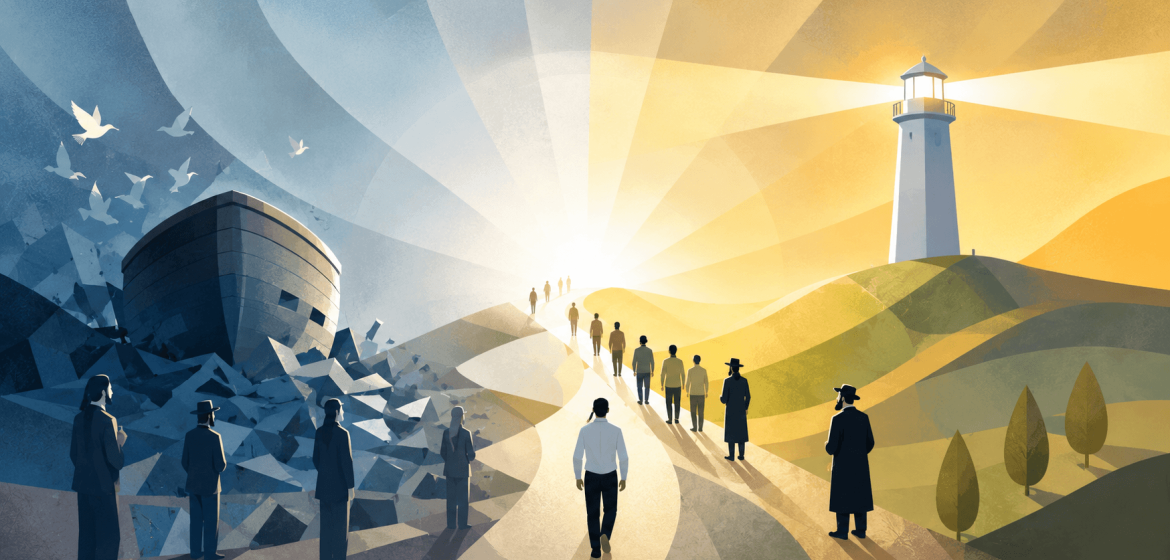
After the destruction of European Jewry, we were a small community struggling for its very existence. We built something akin to Noah’s Ark. Outside, the flood raged; inside, we had to preserve our children, our Torah, and our way of life. That Ark succeeded beyond anything its builders could have dreamed.
But we are no longer a small remnant. We are a large and rapidly growing community with enormous influence over Israel’s cities, its economy, its politics, and its future.
After the destruction of European Jewry, we were a small community struggling for its very existence. We built something akin to Noah’s Ark. Outside, the flood raged; inside, we had to preserve our children, our Torah, and our way of life. That Ark succeeded beyond anything its builders could have dreamed. But we are no longer a small remnant. We are a large and rapidly growing community.
A small community can turn inward and allow others to carry the economic burden. A vast community cannot. Dependence on others is not a viable program for a society that seeks to flourish. It is neither dignified nor sustainable.
A person should aspire to stand on his own feet. As the Gemara teaches, “An adult who remains dependent upon his father’s table is called a minor.” A family should aspire to stand on its own feet. And a community should aspire to stand on its own feet.
Accordingly, our measure of political success must change. The question should not be how many allowances we managed to secure, but how many opportunities we created: How many Charedi men received the tools to support their families with dignity? How many families escaped the cycle of poverty? How many young people gained the skills to participate in the economy without surrendering Torah and Yiras Shamayim?
Instead of speaking about subsidies, we should speak about opportunities.
Not dependence, but independence.
Not survival, but flourishing.
From Excuses to Responsibility
Another painful question concerns our moral and ethical condition: integrity, righteousness, charity, and justice.
“The daughters of Israel are beautiful,” the Mishnah tells us, “but poverty disfigures them.”
Charedi society is beautiful. It contains Torah, family, extraordinary chesed, and remarkable mutual responsibility. But there are also things that cast shadows over that beauty.
Scandals of corruption involving Charedi institutions, public or private, no longer surprise us. Providing false information in order to obtain benefits fraudulently, or registering as a student merely to secure a public-transport discount, have in some quarters become socially accepted practices. In the face of these and similar phenomena, we must say unequivocally: This is not what a Torah society is supposed to look like.
Excuses are plentiful. We can say that everybody does it, that the state discriminated against us, that our institutions desperately need the money.
But more is demanded of us.
In recent years, extremism has also intensified. Distinguished rabbis and Rebbes have been assaulted in Charedi streets, with scarcely a response and often no meaningful condemnation. The verse comes painfully to mind: “Do not gaze upon me because I am dark, because the sun has scorched me” (Shir Hashirim 1:6). It is difficult to look honestly at ourselves in our present condition.
Truth, righteousness and justice, dignity, self-respect, and the willingness to bear responsibility—these are Torah values.
Restoring them to the center of our public life is itself Kiddush Hashem.
From “Them” to “Us”
Perhaps no phrase has shaped Charedi consciousness more deeply than Rabbi Yochanan ben Zakkai’s request: “Give me Yavneh and its sages.”
There are times when turning inward is the height of wisdom. When the world outside is collapsing, one saves the Beit Midrash. One preserves the flame and builds Yavneh.
But time does its work. History does its work.
Today we do not merely live in the State of Israel. Increasingly, we are the State of Israel. And one cannot withdraw from oneself.
We have ministers in government and members of the security cabinet making decisions about war, life, and death—while at the very same time continuing to speak the language of “they will run the country, while we take care of ourselves.”
Who exactly are “they”? And who are “we”?
The simple facts can no longer be denied. Israel’s economy is our economy. Its healthcare system is our healthcare system. Its security challenges are our challenges. Israel’s successes are ours, and its failures are ours as well.
Whether we intended it or not, the State of Israel has become, in the eyes of the world, the public representative of Jews everywhere. The enemies of the Jewish people are Israel’s enemies; Israel’s friends are the friends of the Jewish people. We all understand that the future of the state is the future of our children.
Many of them will enter the world beyond the walls of the Beit Midrash. We must give them the tools to earn, create, lead, and serve—to enter a complex world without fear and to carry Torah with them wherever they go.
There will be profound disagreements. We are Charedim. We have commitments and red lines, and a worldview that will sometimes place us in sharp disagreement with others.
But disagreement does not negate partnership, and difference does not absolve us of responsibility.
The language must change from “them and us” to a collective “we.”
From “their problem” to “our problem.”
From “what can we receive?” to “what can we contribute?”
This also demands a different educational posture. Our children need Torah, yirat Shamayim, and a strong identity. But a strong identity need not entail helplessness.
Many of them will enter the world beyond the walls of the Beit Midrash. We must give them the tools to earn, create, lead, and serve—to enter a complex world without fear and to carry Torah with them wherever they go.
From Noah’s Ark to a Lighthouse
This brings us back to Noah’s Ark. The Ark was necessary. Without it, there would have been no future for Torah Judaism.
But no one dreams of living forever inside an Ark. When the waters recede, the door must be opened.
For generations we built a magnificent Ark. The time has come to move to the next stage.
Not only an Ark. A lighthouse. A lighthouse of Torah.
We must become a society sufficiently confident in its Torah to cast its light far beyond itself. A society whose Torah has something to say about economics and security, technology and welfare, morality and government, family and community, and the proper character of a Jewish state.
We need to stop asking only how the State of Israel can adapt itself to Charedim, and begin asking what Torah—the magnificent Torah studied throughout the Charedi world—can give to the State of Israel.
We did not preserve Torah for generations so that it could remain forever sealed within an enclave. We preserved it because the Jewish people need it. And they need it now.
That is why we need a new Charedi politics.
A politics that knows how to say yes.
Yes to Torah. Yes to livelihood. Yes to service and shared responsibility. Yes to integrity. Yes to education. Yes to opportunity. Yes to partnership.
Not because the state is perfect, and not because our disagreements have ended. But because we can no longer evade responsibility for the broader public.
The people of Israel are our brothers and sisters, and our shared Jewish future lies here.
That is why we need a new Charedi politics. A politics that knows how to say yes. Yes to Torah. Yes to livelihood. Yes to service and shared responsibility. Yes to integrity. Yes to education. Yes to opportunity. Yes to partnership. Not because the state is perfect, and not because our disagreements have ended. But because we can no longer evade responsibility for the broader public. The people of Israel are our brothers and sisters, and our shared Jewish future lies here.
This is not a repudiation of the Charedi project.
It is its next chapter.
The first chapter was survival. The next must be flourishing.
The first chapter was Yavneh. The next must be Jerusalem.
The first chapter was Noah’s Ark. The next must be a lighthouse.
And the Kiddush Hashem of yesterday—the demonstration that Torah could survive—must become the Kiddush Hashem of today: the demonstration of what a Torah society is capable of giving.
The State of Israel, and the Jewish people as a whole, are waiting for us.
That is the challenge—and the responsibility—of our generation.
[*] This piece is an adaptation of an address I gave at the launch of the Tzibur HaCharedi party, which took place in Beit Shemesh on 10th Elul 5786, 23.8.26.


Yasher Koach on your very thoughtful address
May HaShem continue to grow your incredible courage and grant you even greater success.
שנה טובה ומתוקה!
>>>We did not preserve Torah for generations so that it could remain forever sealed within an enclave. We preserved it because the Jewish people need it. And they need it now.
I’m not arguing with anything written here but I am pointing out that the extremists feel the same way. They also believe that their acts of aggression and violence are just a means of spreading Torah observance throughout Israel. Good intentions alone therefore cannot be the measure of whether an approach is right. A Torah community that is known for honesty, kindness, responsibility, concern for every Jew, and genuine kiddush Hashem will certainly accomplish far more for Torah observance than any amount of pressure or confrontation ever could. But the solution suggested here may be on shakier grounds. Is the statement “The State of Israel, and the Jewish people as a whole, are waiting for us.” always true? Is there really no one who has hidden anti-Torah agendas that go way beyond wanting to draft those who are learning due to practical need? Much as I would love to believe the answer is “no” there is too much evidence the answer is “yes” .While I hope this party is successful if it is naïve about who it is sometimes dealing with on the other side the results may not be positive.
But disagreement does not negate partnership, and difference does not absolve us of responsibility.
How is this sentiment (which I endorse wholeheartedly) any different from that of Rav Reines and the Mizrachi, for which they were attacked relentlessly by the Aguda.