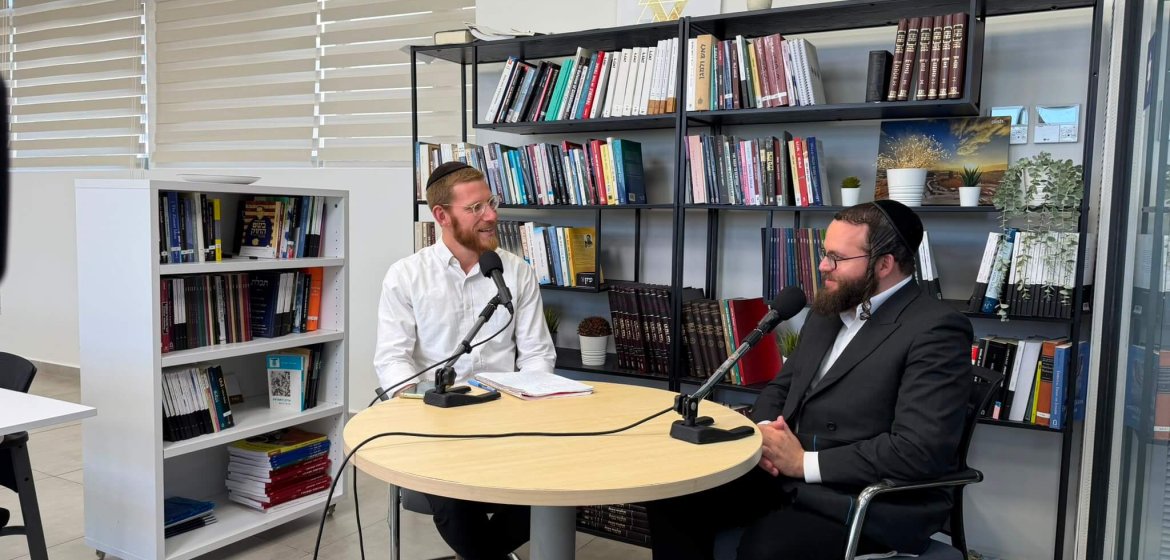

A man wakes up one morning, discovers that he is a political party, and starts walking. Or perhaps that is not quite how it happened? When we ask Moti Leitner, chairman of the new “Haredi Public” party now running for the Knesset, he says this is simply the natural continuation of what he has experienced over the past several years.
I see up close the accumulation of acute problems, the pain within our community that keeps intensifying, and I struggle to see any light at the end of the tunnel.
“I’ve worked for a living in recent years as a software developer, but I also serve as deputy mayor of Beit Shemesh. I see up close the accumulation of acute problems, the pain within our community that keeps intensifying, and I struggle to see any light at the end of the tunnel. All of this led my colleagues and me to the conclusion that the time has come to act. And by act I mean: the time has come to establish a new Haredi political party.
“A party that will sanctify God’s name rather than desecrate it; that will pursue real solutions, addressing problems at their root rather than perpetuating the present situation out of some desire to preserve an imaginary status quo; a party that will look at reality soberly and realistically, and conduct itself with honesty, integrity, faith, and responsibility.”
The word “responsibility” seems to follow you everywhere. You use it almost as a banner, even a slogan.
“It isn’t a banner, a declaration, or a slogan. It is something that shapes identity. It is a very deep idea that is not sufficiently rooted in our society, and we need to educate toward it, live by it, and understand the deepest implications of what it means to take responsibility: responsibility for our families, for our communities, for society, and for the country.
“For many decades, perhaps we could afford to conduct ourselves as though we were some marginal group that could grow quietly off to the side, live in relative anonymity, and not fully participate in either the duties or the privileges of the broader society. But the blessed growth of the Haredi public—from roughly two percent of the population to more than thirteen percent today, with far greater numbers expected in the future—means we have to understand that if we continue as we are, we can end up in one of two places.
“One possibility, which is the direction we are currently heading, is that Haredi society will drag the economy into stagnation and regression. We will go from being a developed country to a developing one, by every economic metric and parameter. We will crash. There is no economic model that can remain sustainable with the patterns currently embedded in Haredi society at their present scale. And that is before we even begin talking about the army, the social situation, or the Torah dimension.
“But the opposite can happen too. Haredi society can accelerate—strengthening and expanding trends that already exist within it, just not yet on a sufficient scale, and giving them the power to grow. We can become the locomotive pulling the State of Israel toward stable, sustained prosperity, strengthening its national, security, and economic assets—and, of course, its moral and Torah foundations.”
As a member of the next Knesset, God willing, where would you begin in trying to solve these problems?
“First of all, the problem is the absence of any serious thought or strategic planning—five years ahead, ten years ahead, several decades ahead.
“Take the education system. Its purpose is ultimately to build a person spiritually, but it also has to provide certain tools and skills. A boy is supposed to grow into an adult with the capacity, at the very least, to support his family.
“We know that we give our children the tools and capacities to become servants of Hashem and bnei Torah. That is what the separate Haredi educational systems are built around, and that is their primary purpose. But there is another capacity that matters too: the ability to fulfill what we undertake in the ketubah, to do what Chazal require of us and what the Holy One, blessed be He, demands of us—to support our families with dignity, to be the Zevuluns who support Torah and those who devote their entire day to learning.
- Prof. Moshe Koppel: The Hopes Of a Younger Generation
- What Israel’s Jewish Awakening Demands of Us
- When Prayer Becomes Performance: Selichot, Music, and the Theology of Experience
- The Voice That Would Not Be Silenced: Kol Nidrei, Halacha, and Jewish Memory
- Who Gets Our Understanding? Between Yordim and Haredim
“We already see today that the Jewish world mobilizes substantial resources to support Torah study: the state supports it, philanthropists support it generously. But those who go out to work—and today that includes most Haredim in Israel—find themselves, overnight or one bright morning, in a state of culture shock. They encounter life, and life hits hard. Reality hits hard. It is simply difficult.
“We do not have the tools, the capacities, or the basic skills needed to earn a proper living in the modern labor market. Someone who wants to realize his earning potential, rather than settle for a low-level job that brings in a few thousand shekels, has a very difficult road ahead. I don’t mean to belittle honest work, but we may be leading our community toward becoming the hewers of wood and drawers of water of the State of Israel.
I am talking simply about making our community strong, prosperous, and secure; ensuring that there are people capable of supporting Torah and Torah scholars; ensuring that Haredi children stop being the poorest children in the State of Israel.
“And once you understand that this is economically wrong, and that it is also wrong in Jewish and moral terms, you understand why people want to make proper use of their abilities and talents. I am not talking about modern ideals of ‘self-actualization.’ I am talking simply about making our community strong, prosperous, and secure; ensuring that there are people capable of supporting Torah and Torah scholars; ensuring that Haredi children stop being the poorest children in the State of Israel; ensuring that our sector ceases to be one that, regrettably, according to all the empirical economic data, draws substantially more from the public purse than it contributes in direct and indirect taxation.
“And again: if this worked, if the model were sustainable, we would not need to do anything. But it doesn’t work. It is collapsing in on itself.
“Thousands of families are rolling one gemach loan into another. Parents do not know how they are going to put bread on the table, how they will make Shabbat, how they will get to the end of the month. Kollel men are running from one job to another, frustrated and angry. It affects everything: shalom bayit, mental well-being, and the moral and normative health of the society in which we live.
“And this is not a decree of fate. It does not have to be this way.”
It is true that Haredi Knesset members champion this approach, but ultimately it comes from the education system, from rabbis and yeshiva heads. To a large extent, the politicians represent the classical Haredi educational line. What do you want from them?
“The truth is that I no longer have expectations of the existing Haredi Knesset members. Some of them occasionally say, ‘What do you want from us? We’re working.’ And I would say that what they are really doing is pulling the wool over our eyes.
“When there is no vision, no plan, no tools or capabilities, and the entire approach is to bury your head in the sand and sweep as many problems as possible under the carpet—there are no problems; if there are problems, they have nothing to do with me; if there are needs, I wasn’t elected to address them; if there is a need to take spiritual responsibility for Haredi soldiers serving in the IDF, that isn’t our job—then our representatives have reduced the scope of their responsibility to such a tiny box that Haredi society first looks at them in disbelief, then in astonishment, and finally in anger, asking: What have you actually done for us?
The truth is that I no longer have expectations of the existing Haredi Knesset members. Some of them occasionally say, ‘What do you want from us? We’re working.’ And I would say that what they are really doing is pulling the wool over our eyes
“And the answer, sadly, is: nothing. Perhaps they didn’t try. Perhaps they aren’t capable.”
So is the solution parliamentary? Is politics where the solution lies?
“I believe that in the State of Israel, when there is no Haredi representation in the legislative and executive branches that sanctifies God’s name and takes responsibility, our existing MKs have struggled even to respond to the present crises. They certainly will not be the ones to bring real hope to young people waiting for serious, substantive solutions. And they certainly will not give expression to the aspirations of rabbis, rebbes, and community leaders who want something different for their communities—while the existing politicians fight them.
“I’ll say something difficult. There is a leader of one of the existing parties who, over the past year, has devoted himself not primarily to protecting Torah learners, not to developing realistic and healthy solutions, and not to finding a legal formula that could protect yeshiva students. There is one issue over which he runs all over the country: whenever he sees institutions trying to move from the recognized-but-unofficial system, the exempt system, or one educational network into the state-Haredi system, he threatens them aggressively.”
Which politician?
“The head of an existing party who has made a virtue of bullying, who has declared war on rabbis and rebbes trying to create better solutions for their own communities in accordance with their worldview and religious outlook.
“And so long as there is no additional Haredi party in the Knesset, so long as the authentic voice of so many communities within Haredi society has no political expression, and so long as there is no Haredi representation that says, ‘We cherish Torah, we want a flourishing Torah world—but we also understand what it means to take responsibility for ourselves and for our children’s future,’ then regrettably the dominant line will increasingly become the policy of the bullies of the Jerusalem Faction.
“It is a process of radicalization, of widening the divide, of brazenness and lack of basic respect toward other parts of Israeli society. There is a kind of arrogance and audacity that I find hard to understand. Sometimes you hear disgraceful statements and witness repulsive behavior—remarks that seem almost designed to drive an arrow into the hearts of bereaved mothers and other sectors of society. We sent representatives to repair, to bring people closer, to improve things for Torah and Torah scholars and for the Jewish people as a whole. They are doing precisely the opposite.
“So it is time to repair this too. To sanctify God’s name, to restore the crown to its former place, and to make visible in the public sphere a Haredi representation that is more Jewish, more Haredi, more humane, and more sensitive.”
What does this look like in practice? Suppose you are an MK and we take economics and education. What do you actually do?
“The most urgent tasks are, first, to regularize the status of genuine yeshiva students—and that can happen only by taking responsibility and understanding that everyone else has to serve.
“Second, to give our children the tools they need, in both formal and informal education.
“And third: employment, employment, employment. We need to work relentlessly on this, to declare war on poverty and try to eradicate it. Poverty is damaging us.
“Go back for a moment to children’s education. If we understand today that over the coming decade skills such as English and mathematics—which are not values, but tools—will be essential, and that they are the minimum needed for a child eventually to pursue academic studies or professional training without wasting enormous amounts of time and money, then we have to teach them. Fifty percent of Haredi students drop out of higher education and fail to reach the point where their studies allow them to support themselves.
“We need to understand that these are things that should be learned in elementary or secondary school—or at the very least through evening programs or vacation courses. And we certainly should not be fighting institutions that want to incorporate professional or general studies into their educational framework. Yet today, people are fighting them.
“That is one essential element. Then, at later ages, we need professional colleges and academic centers. We need to do everything possible to ensure that anyone who chooses to support his family has a wide range of options—genuine freedom of choice—and does not have to travel to other cities or distant parts of the country simply to acquire a profession in a way that makes it impossible to work and study at the same time.
“In the city where I live, for example, extensive efforts are underway to bring a major professional-training complex into the heart of the city, allowing a city of nearly 200,000 residents to acquire knowledge and professions that will enable them to earn a living. Militant and radical elements within Haredi society have declared war on the project, and regrettably it has not moved forward.
“We need the courage and leadership to declare war on that kind of bullying. We do not interfere with communities that believe differently. People have freedoms. Individual liberty allows them to choose a different way of life for themselves and to educate their children differently. We all believe in that. But the same principle applies in reverse: don’t interfere with us. Don’t interfere with the education of our children. Don’t damage our children’s education. Don’t damage the future of our community.” Pasted text
“All the Candidates Are Committed to the Party’s Vision”
A month or two ago, when the campaign surrounding your attempt to join United Torah Judaism began, you suddenly burst into Haredi public life. I had never heard your name before, and I assume there are still many people who do not know who you are.
In a few words: Who are you? Where did you come from?
“I grew up in the Rachmastrivka Hasidic community. Today I am married with four children. I work as a software engineer and trained as a teacher. My intellectual formation came first and foremost through the Iyun Institute and the Center for Liberty. My background was in the exact sciences, mathematics, and English. I had always had some interest in broader thought, but the humanities and related disciplines were almost a foreign world to me. At an Iyun Institute seminar, I encountered them systematically for the first time, and they had a profound influence on me.
“In that sense, I see myself as a product of the Iyun Institute’s beit midrash, alongside Hashiloach and books published by Shibolet, which also influenced me greatly. If I were to use the analogy of a rabbi and student, I would say that this was the beit midrash that taught me a substantial part of my Torah during certain formative years. From there I continued onward and expanded my knowledge in other areas, but it has remained the intellectual and philosophical anchor underlying my public activity.
“One of the most important things I received there was exposure to the world of conservative thought. As a graduate of the Haredi educational system, I had almost no familiarity with the intellectual axes of that conversation, either positively or negatively. Iyun brought that world to me, and that exposure became an important part of the way I understand economics, public policy, geopolitics, and historical processes—alongside Torah ideas, which also receive important tools of expression there.
“Beyond the knowledge itself, it broadened my horizons: it took me beyond the private, familial, and communal circles and taught me to look at the larger whole, and at the individual’s place within history and society.
“I doubt that my transition from private life into public life would have happened in the same way without the orientation and exposure I received there. The process that began there taught me to look beyond the particular, to understand broader processes, and to develop a sense of responsibility and commitment toward Klal Yisrael that I had not previously possessed in the same way. In that sense, it made a decisive contribution to shaping my intellectual worldview and to my willingness to act on behalf of broader communities beyond my own family and community.”
How would you define your partnership with Rabbi Yehoshua Pfeffer?
“My partnership with Rabbi Pfeffer is extremely significant to me. He brings firm foundations and basic principles rooted in decades of experience as a rabbi in Israel, a dayan, and a lawyer. His entire life has been lived at the meeting point between idea and practice, and between religious, Torah, and halachic thought on the one hand and legal and practical reality on the other.
“At the same time, he brings intellectual clarity and highly coherent thinking, grounded in a developed worldview that connects Jewish thought with broader intellectual traditions. One of the most important things Rabbi Pfeffer brings, in my view, is the ability to demonstrate clearly how Judaism, in its deep and essential sense, can coexist with conservative ideas that modern society badly needs.
“Haredim who open themselves to the wider world sometimes gravitate toward radical, deconstructive ideas from the intellectual world of the liberal Left. Rabbi Pfeffer shows that this is not inevitable. There is another way.
“To me, Rabbi Yehoshua is a figure who brings several worlds together: deep intellectual experience, experience as a rabbi and lawyer, and an intimate familiarity with the practical world. He embodies a combination that is difficult to find in one person. And, incidentally, he has also been speaking for years about the need to assume deep responsibility.
“In that context, I would point to the two analogies Rabbi Yehoshua himself used in his speech at the launch conference, both of which all of us identify with: the transition from a ‘minor dependent on his father’s table’ to an adult standing on his own, and the analogy of leaving the ark—the Haredi Noah’s Ark. Both express the same direction: moving from insularity and dependency toward entering the world, assuming responsibility, and acting within it. For me, the guidance, mentoring, and path he is charting are meant to give the Haredi world the tools to make that transition—to a responsible, maturing Haredi identity that also acts within the practical world.”
Not every candidate on your slate, however, comes from your background.
“I cannot necessarily say that every candidate has an equally rich or developed intellectual background. But I can say that eleven of the twelve candidates are fully aligned with the party’s positions and direction. Naturally there are stylistic differences and differences between individuals. And in Haredi society in particular, sometimes it seems that as soon as someone discovers that he agrees with his friend, his instinct is immediately to search for the differences and sharpen the points of disagreement.
“But at the level of positions, there is clear alignment. Every candidate is committed to the party’s vision.
“Dr. Nechumi Yaffe, for example, brings unique expertise in the areas she works in, particularly everything connected to Haredim in academia. On those subjects, there is no one better suited to articulate a position and take action. She fully accepts the party line and the positions as we have formulated them, and is committed to the party’s spirit, vision, and platform.”
What do you say to people who are afraid to vote for you because of the electoral threshold?
“The electoral threshold is indeed a very significant obstacle to our ability to give political expression to our voice. I had hoped that alliances would be possible, allowing us to operate as a bloc and receive realistic representation within other parties. That did not happen, so we have no choice but to try to run independently and cross the threshold.
“We do see considerable potential public support—around 70,000 Haredi voters who want different representation—and in a broader scenario we see potential support equivalent to roughly six Knesset seats. But we are also realistic and rational people, and we will act in accordance with reality.
“The concern about the threshold has also led me to think more broadly about the structure of the electoral system. I think parties that fail to cross the threshold should still be able to enter surplus-vote agreements. That way a voter could give a new party a genuine opportunity while knowing that, if it fails to reach a certain threshold, those votes could pass under the agreement to another party. That could reduce the risk of a vote being wasted while still preserving a sufficiently meaningful entry barrier to prevent an unreasonable proliferation of small parties.
“That is an idea I intend to advance under any future scenario, whether or not we succeed in entering the Knesset.
“Ultimately, the current political reality makes this kind of representation especially difficult because political discourse is so heavily concentrated around the axis of ‘yes Netanyahu’ or ‘no Netanyahu.’ Within that polarization, existing political currents—and a large public seeking different representation—find it difficult to gain independent expression. We know that there is a significant Haredi public that wants something different, and we hope to cross the threshold not only through Haredi voters but also through voters from other sectors of Israeli society who identify with the direction we are proposing.”
“We Know How to Offer a Realistic Solution to the Draft Issue”
For the past several years, Leitner has served as deputy mayor of Beit Shemesh. He says that there, too, he brought something that had previously been missing from the city council.
“I established an initiative through which we succeeded in bringing two representatives into the Beit Shemesh municipality, and I have been active in public life for several years. There too, we introduced something new: Ashkenazim, Sephardim, immigrants, Litvaks—together. The tribes of Israel. Klal Yisrael.
“We built a federation of communities and succeeded in securing representation that works on issues that mattered to us but had never previously received political expression: representation for communities of working Haredim; solutions for the problems of immigrants who have lived in Beit Shemesh for twenty years without anyone paying attention to them; advancing quality-of-life issues and placing them among the top five priorities we promote; cultural events aimed at the entire population, with genuine variety rather than only one particular type of event.
“What we are proposing here is something much larger, much more significant, and much more deeply rooted in identity. God willing, it also speaks to a much broader cross-section of society—not only those who feel they have no place within the existing frameworks, but also the mainstream, the broad Haredi public. Forty or fifty percent of Haredi society sees us as people who can realize their aspirations, who can give expression to their deepest frustrations.
“And we are confident that the potential we are aware of, that we see and sample, can be realized—and that we will succeed in sanctifying God’s name.”
I saw the videos of you at the IDF induction center. I found them moving. I felt that for once I was seeing a Haredi public representative coming to embrace the parents, embrace the soldiers, and stand behind them in the face of all the shouting.
Now I am trying to understand what is new in your approach to the draft law. I have heard you say: Anyone who wants to learn should remain in yeshiva. But that is exactly what the existing Haredi parties say: those who are learning should remain in yeshiva.
“First of all, that should never have been a headline. A Haredi public representative coming to embrace and support Haredim entering combat service should not be newsworthy in any way. It should be completely obvious. Goldknopf, Deri, Gafni—they all should have been standing there, encouraging these young men, supporting them, strengthening them, and saying thank you.
“But instead we see something else. We see our political representatives ignoring them, treating them with contempt, maligning them, mocking them, and working to damage both them and the frameworks in which they serve. Not only do they fail to help them; not only do they fail to think about how to improve those frameworks and strengthen the religious solutions they provide—they completely ignore their responsibility toward those young men.
“They can pay lip service to the statement that ‘anyone who isn’t learning should serve.’ But they don’t mean it. We see them repeat it hypocritically in campaigns while doing nothing. It isn’t enough to say it; you have to act on it.
“Ask anyone working in the field. Just as for seventy-six or seventy-seven years the army did not really want Haredim in the IDF, Haredi politicians never seriously tried to formulate or make accessible a model that allows a Haredi to enter the IDF Haredi and leave it Haredi. They never took responsibility.
“Are they exclusively to blame? No. The sovereign—the state—also completely ignored this need. We allowed ourselves to dream about a small, smart, lean army, imagining that we would no longer need large numbers of soldiers. There was almost a widespread sense of ‘the wolf shall dwell with the lamb.’ October 7 shattered that illusion in all our faces. We realized that we need tens of thousands more combat soldiers and tens of thousands more support personnel. And the population most readily available right now to step forward, help, and assume responsibility for our children’s future and for the future of the country in which we live is the Haredi public.
“Only a handful of people—and they are not part of the old political leadership—stepped forward and helped establish the Hashmonaim Brigade, the Kodkod program, the Yoav program, and other technological and combat frameworks within the IDF that, for the first time, allow a Haredi to enter military service and receive appropriate religious conditions, conditions that enable him to remain who he is.
“That is exactly what we mean when we say that we know how to offer a realistic solution. If the IDF currently needs four, five, or six thousand Haredim a year, and tens of thousands over the coming decade—here they are. They are here. They are no longer in the yeshiva study halls. They exist. They are working, wasting time, looking for themselves.
“Let us help them. Let us bring them in. Let us show them that it is possible to grow spiritually in the army, that it is possible to maintain a serious religious standard. We have responsibility for them inside the army too: kashrut, prayer, Torah classes, rabbis. Let us show them and their families that it is better for them not to remain idle outside, but to enter, contribute, and take responsibility.
“They will benefit. Our community will benefit. The country will benefit. And most importantly, when we do this and genuinely work toward it, the yeshiva students in the holy yeshivos will be able to sit and learn without interference.”
What is the model? How would it work? Define it. What kind of law could pass both Supreme Court scrutiny—which, unfortunately, has to be taken into account—and the test of public legitimacy?
“The precise method, mechanism, and detailed definitions are not the main story. They are part of the story. But when seventeen Haredi MKs sit in the Knesset and, no matter what comes out of their mouths, are ultimately pursuing one goal—that no Haredi should serve in the IDF, that no Haredi should be able to enter the army Haredi and come out Haredi—then everything else is cover and sleight of hand.
“I’ll give you one example. There are fourteen Haredi hesder yeshivos. Not every young man is suited to a hesder yeshiva; after all, these institutions also involve years of serious Torah study. Some students learn Torah every day, some combine it with degree studies, and some are halachically and personally ready immediately for full military service, whether combat or support roles.
“But those yeshivos, some of which have existed for more than a decade and others of which have emerged in recent years, not only receive no state funding; they are treated disgracefully, dismissively, and offensively. They are not recognized, they receive no help with construction, no help with operations. They live from hand to mouth.
“If we took responsibility for these yeshivos and were proud of them, and showed people that there is another path available to a Haredi individual and to the parent whose son is struggling, then instead of sending him to a yeshiva for struggling youth, that parent could send him to such a framework. He could grow stronger spiritually, acquire a profession, and ultimately enter the IDF.
“We would not see a few hundred students in these institutions; we would see thousands. And from this one relatively small solution alone, a substantial part of the problem would begin solving itself. And I have not even begun to discuss the many other possible solutions.”
But that still does not resolve the legal deadlock. Ordinary yeshiva students in ordinary yeshivos still have no legal solution.
“There absolutely can be a legal solution. Yeshiva students should be able to learn under the best possible conditions, free from the threat of arrest. But when people come along and say ‘exemption for yeshiva students,’ ‘deferment,’ ‘Torato omanuto’—his Torah is his occupation—and on the other side offer nothing about what does happen, how it happens, or when it happens—nothing at all—what do they expect?”
The real issue is the legitimacy we Haredim accord to the state in the first place.
“That is certainly one element, but I disagree with you. I think the entire debate over legitimacy, recognition, or whether we have normalized our relationship with the state has become ridiculous and pathetic.
“It is like two people standing beside a tree, arguing with great sophistication and waving their hands: Do we recognize the tree, or do we not recognize the tree?
“Enough. Come on, gentlemen. It’s over. The state exists. It is prosperous and strong. We love it. We appreciate it. We are part of it. Whether you approach the question in essential, practical, or ideological terms—we are there.
“Haredi cities are part of the state. Government money flows into them. The roads, the schools, the Talmud Torahs, the cultural events—we are part of the state.
“Even if we never stand up and announce that we are great Zionists, we are Israelis—all of us, apart from certain groups that genuinely maintain separation and are consistent about living according to that worldview.
“This realization may have penetrated more deeply in some places than others. Younger people perhaps feel much more a part of Israeli society because of other developments as well: exposure to technology, greater contact with other parts of the population through social media, and other phenomena. But they are no longer living in the old paradigm.
“The question is no longer whether or not we recognize the state. The problem is that we have not internalized the value of our own responsibility. The state is us. Very soon, the Haredi public will be a highly significant and active part of the country, and we want to take responsibility for our own future. It is no longer ‘them.’ It is ‘us’—another idea Rabbi Pfeffer emphasized in his speech. We are here.
“As for your question about why there is so much fear of military service, of course there is also a kind of inherited trauma from centuries of Haskalah, Reform, and secularization. Those motifs certainly exist. There is profound fear and anxiety. It is also true that for eighty years the sovereign itself allowed us to arrive at this point. The army looked at us and effectively said: fine, fine, we will accommodate you; we don’t need you.
“But we need a prosperous and powerful country. Any thinking person understands that if we want to survive here, in this hostile region, for many years to come, we have to do this. Unless someone comes along and says: Gentlemen, we want a separate autonomy in Uganda or some other country; let us leave Israel and flourish somewhere else.
“I don’t think that would even be economically possible. But if we are honest with ourselves—we want to live here. We want to be in Zion. We want to witness the redemption of the people and the land. We want to see the Holy One, blessed be He, cause His Shechinah to dwell among us. We want to see the Temple rebuilt. We want to see the wholeness of the Jewish people and the building of the spiritual edifice of Torat Eretz Yisrael.
“We want to see the country of which we are part succeed. So let us be part of it. Let us stop lying to ourselves.” Pasted text
At this point it is simply no longer possible to remain outside. We are already such a large share of the population, and we continue to grow. I saw figures today showing that Haredim already make up around twenty-seven percent of first-grade pupils, with the figure expected to rise far higher. Ultimately, there is nowhere else to go. We are going to be here.
“Exactly. Our community is the future. So let us make sure that future is better, stronger, and of higher quality—for ourselves, for our children, for the very children we are talking about.
“We should remember that Noah’s Ark was ultimately not only about entering the ark and withdrawing from nature. There was also the exit: the return to building, flourishing, and rebuilding human civilization.
“We have already survived the Flood. We survived, we built, we succeeded. The project was a success: a magnificent Haredi society, a model community, a society rooted in values and holiness. A world of Torah and chesed on a scale that history has scarcely known. A society of giving, of kindness, of values.
“In a world of hedonism, in a world of capitalism for its own sake, in a bourgeois world, we have preserved a values-driven society—a model society.
“But alongside that achievement, the time has come to add another layer, another level, another floor to the structure we have built. To move forward, to strengthen it, to fortify it.
“Again, if everything were working—if the system were successful and complete, if the algorithm functioned—we wouldn’t be needed. But it is full of bugs. Problems are accumulating, distress is mounting, and they need to be addressed with maturity, seriousness, and clear eyes.”
Unfortunately, Haredi parties tend to lean left economically—at least some of them. Their instincts can be rather socialist. I understand that your views are different.
“You can see it in their resistance to necessary market reforms. They have simply advanced positions that are utterly detached from economic reality.
“It is the same absence of responsibility. The same positions reflect a profound lack of knowledge and understanding of the necessity and value of a free market. They produce an almost childish attachment to entrenched institutions, to pampered guilds that have survived from a quasi-communist era, instead of dismantling them. And the cost of living weighs on our own community more heavily than on almost any other. We are the poorest population in the State of Israel.”
Who is the father of this party?
“You, for example.
“For a full year I have been traveling across Israel from one end to the other, speaking to rabbis, rebbes, community leaders, residents of every Haredi city, and people throughout Israeli society. And I keep discovering just how turbulent things are beneath the surface; how loudly people are crying out; how deeply they long for someone to do what we are doing; how widespread the despair is and how much the frustration has grown.
“So who are the father and mother of this party? The public. The people. The citizens.
“My colleagues and I are simply giving them a voice.
“And we will do our best to represent them faithfully and honestly.”

