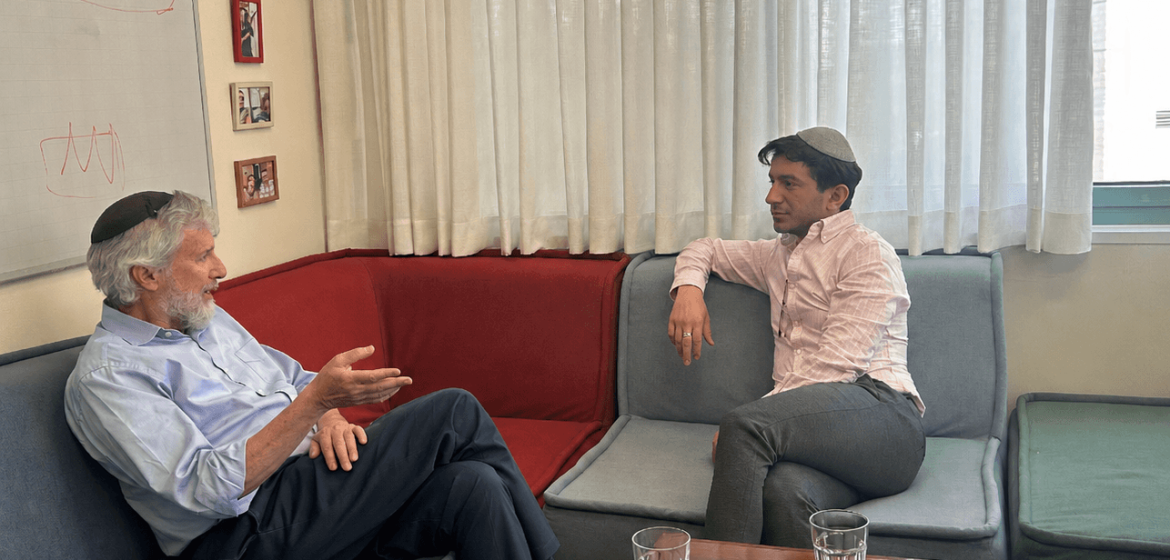

The quiet that greets me as I enter the pleasant offices of the Kohelet Policy Forum in Jerusalem stands in almost ironic contrast to the political storms that have become associated with the organization.
At the height of the protests against the judicial reform—some of whose ideas drew on policy papers produced by the institute—protesters barricaded its entrance with stones, sandbags, and barbed wire. Although the forum’s founder and current chairman, Prof. Moshe Koppel, maintained an active and substantive dialogue with leading opponents of the reform, protesters identified Kohelet as a source of the threat to the established political order and took aggressive action against it.
The entrance lobby contains one striking design element: large limestone blocks arranged in two narrow, symmetrical rows along its left-hand side. When I see them, I cannot help wondering whether they are an intentional reference to that episode.
Koppel meets me in his office and, after exchanging greetings and some pleasant small talk, invites me into a quiet conference room. We begin, inevitably, with the hottest of hot-button issues: the relationship between Haredi society and the State of Israel.
Koppel was born and raised in an observant Jewish home in New York. He attended Haredi schools before earning his undergraduate degree at Yeshiva University and a graduate degree at New York University. At the age of twenty-three, he received a doctorate in mathematics, after which he completed postdoctoral research at Princeton’s Institute for Advanced Study.
That impressive trajectory—from the shtetl, so to speak, to the heights of academia—might appear to offer an obvious model for Haredim in Israel. Koppel himself is reluctant to see it that way.
“People will decide for themselves whom they want to regard as a model,” he says with a faint smile, “but I wouldn’t particularly recommend looking in my direction. First of all, how many mathematics postdocs does the world need? And second, the path I took was not especially unusual. I was one of the few who pursued academia at that level, but all my friends went out to earn a living—in business, higher education, or public service. There are several roshei yeshiva from my class, some of them quite well known, but they are actually the exceptions. Most people simply went to work. That was the norm.
“Also, the homes we grew up in were not what people here would call ‘Haredi homes.’ These were deeply observant Jews who had come from Europe, kept the mitzvot, and sent their children to religious institutions that fell somewhere along a broadly Haredi spectrum. Many of the characteristics associated with Haredi society in Israel simply weren’t present in that community. So I don’t think the environment in which I grew up should be viewed as a model that can simply be transplanted into contemporary Haredi society.”
The world he grew up in appears to have helped inspire his 2021 book Judaism Straight Up, which stresses the importance of tradition, alongside halakha, in shaping a conservative Jewish way of life.
In Koppel’s view, the Haredi society familiar to Israelis today is a distinctly Israeli creation, produced by specifically Israeli circumstances. Does that mean that changing Haredi behavior must begin by changing those circumstances? Would exempting Haredim from military service, for example, as in the United States, enable a smoother transition into employment and higher education?
“The American model is very relevant to Israel. In other words, forget for a moment what American religious Judaism looked like when I was growing up and look at the current reality. If you go today to Haredi concentrations in America and spend time among the guys there, you’ll discover that they are all hard-core Haredim—but almost all of them work. That is because the circumstances in America create a different model. The state does not subsidize kollel study at the expense of employment. If you decide that you want to sit and learn, you certainly can; nobody stops you. But you have to find a way to pay for it.
“Here, by contrast, a model was built that enables a very large group to rely on a state-funded economy that allows Haredi men to survive without participating in the workforce. As that group grows, the arrangement becomes increasingly complicated. And of course, it doesn’t end with employment. If you don’t expect to be part of the workforce in the future, you also have no internal incentive to become proficient in basic subjects such as English, mathematics, and perhaps science. So it becomes a self-reinforcing loop.”
Koppel nevertheless qualifies the comparison with America. “There is ultimately a cultural element here as well, and American Haredim are themselves beginning to copy aspects of the Israeli model. Some avreichim don’t work, and in recent years elementary schools have opened that do not teach a core secular curriculum. But that remains the exception. It is not how the mainstream functions.
I do accept the argument that the historical linkage between deferment of military service and a prohibition on employment or academic study during the deferment period was a mistake—and a destructive one. You cannot prevent a person from working or studying, even if you also want him to contribute to the country’s security effort.
“As for exemption from military service, you are not doing Haredim any favors if you exempt them from an obligation that you impose on the rest of the population. But I do accept the argument that the historical linkage between deferment of military service and a prohibition on employment or academic study during the deferment period was a mistake—and a destructive one. You cannot prevent a person from working or studying, even if you also want him to contribute to the country’s security effort.”
So when you think about designing a sustainable Haredi model, the main change you would propose concerns government funding for non-participation in the workforce.
“Exactly. Haredim are no different behaviorally from any other population. Human beings respond to constraints and to the conditions around them. If the conditions dictate different behavior, people will behave differently. But I don’t want that to come about through some kind of external coercion. The conditions the State of Israel should create are ones in which every citizen feels at home here—and therefore wants to be a partner in the state and contribute to its prosperity.”
That brings us to a broader question: What, in your view, prevents Haredim today from feeling part of Israeli society, and which elements of that can actually be changed?
“When the state was established, a new reality came into being. Jews suddenly had to adopt entirely new modes of behavior and relate differently to the government, which, unlike in exile, was now Jewish. Religious Zionists interpreted that transformation as redemption, or at least as the beginning of redemption, and viewed the State of Israel as ‘the foundation of God’s throne in the world.’ Haredi society responded with suspicion and reservation.
“The Haredi interpretation essentially transplanted the mindset of exile into the Israeli reality. Out of what I regard as intellectual laziness, they decided that nothing had fundamentally changed: Jewish government in the Land of Israel was really just rule by gentiles who happened to speak Hebrew. And just as the Jew in exile had to deal with a gentile ruler through maneuvering and stratagems, here too the basic approach became one of figuring out how to outmaneuver the government and extract the greatest possible benefit from it. Just as every Jew tried to avoid serving in the Polish or Russian army, here too there is an attempt to avoid serving in the IDF.”
But here, he says, a contradiction emerged that did not exist in quite the same way in exile.
I remember that during one of the previous rounds of cuts to yeshiva funding, one of the Haredi rabbis said, ‘There were never decrees like this even in Poland.’ A friend of mine immediately replied with a smile: ‘Quite right. As a matter of historical fact, the Poles never cut yeshiva budgets.’
“In exile, at least, the relationship was coherent. You tried to evade the gentile because he was antisemitic, and accordingly you also weren’t expecting him to give you money. I remember that during one of the previous rounds of cuts to yeshiva funding, one of the Haredi rabbis said, ‘There were never decrees like this even in Poland.’ A friend of mine immediately replied with a smile: ‘Quite right. As a matter of historical fact, the Poles never cut yeshiva budgets.’
“In other words, here they simultaneously regard the Zionist state as a gentile that happens to speak Hebrew, while relying on its Jewish conscience to fund a Torah way of life. When Rabbi Shach criticized secular Israelis and asked, ‘In what sense are you Jews?’ he was essentially saying: You are Jewish because you recognize that I am preserving the ember of Judaism on your behalf. You need me to preserve Judaism for you while you serve in the army, work, and fund kollelim.
“Either the state is Jewish or it isn’t. You can’t have it both ways.”
“An Ethos Grows from the Bottom Up”
Haredim have been part of Israel’s governing coalitions for many years. In the current government, observant Jews constitute a majority. The broader Israeli public feels that it has done its part by accepting the religious status quo. And yet Haredim still feel like a minority, because they stand outside an Israeli ethos that regards them as guests. Perhaps, then, part of the problem lies in the Israeli ethos itself?
“Look, in the early years of the state, religious immigrants arrived here and had their sidelocks cut off. I have no interest in whitewashing what happened. The Mapai establishment looked at immigrants, religious Jews, and traditional Jews as remnants of the past. In the eyes of some of them, these immigrants were little more than human debris. They wanted to create a new Jew here—the handsome, confident Israeli ideal—and the diasporic Jew did not fit into that vision. These things happened.”
At the same time, Koppel says, one cannot deny the dramatic transformation that Israeli society has undergone since then. The vision of the “new Jew” no longer poses the threat it once did.
An ethos cannot be decreed. It grows from the bottom up. Each community shapes its own ethos, and a healthy society creates the conditions for a broader shared ethos to emerge. The State of Israel needs to create conditions in which every Jew feels at home. Once that happens, the walls will come down.
“The ‘new Jew’ is much less relevant today. Haredim are no longer genuinely threatened by the old Mapai vision, so it is time to stop being afraid and begin taking part in the state. An ethos cannot be decreed. It grows from the bottom up. Each community shapes its own ethos, and a healthy society creates the conditions for a broader shared ethos to emerge. The State of Israel needs to create conditions in which every Jew feels at home. Once that happens, the walls will come down.
“Those walls are no longer relevant. They came from Europe, and they don’t fit a Jewish state whose citizens are Jews. The conditions I’m talking about are environmental: a flag with a Star of David, a broadcast that includes biblical verses and relates respectfully to tradition, or simply the fact that a state has been established in the Jewish people’s historic homeland. Different things speak to different people. But once every Jew feels at home here, talking about the state as though it were Poland or Lithuania or Morocco will simply disappear, because it will sound absurd.
“The second point is that an atmosphere has to be filled with content. And that content cannot be dictated from above; it has to emerge from society itself. Once the right conditions exist, a kind of evolutionary competition develops. If every community asks itself how to build an exemplary society, with a clear moral code and decent human beings, then the community that does this best will ultimately prevail and come to occupy most of the space—especially if it also enjoys a demographic advantage.
“Right now, the demographics may favor the Haredi community, but that doesn’t help it because broader Israeli society does not see it carrying a compelling moral banner. People ask how it can be that even in a national emergency, Haredim choose not to shoulder the burden. When the Religious Zionist community raises the banner of combining Torah with a healthy sense of national responsibility, Haredim can potentially draw inspiration from that, and secular Israelis can as well. But it has to come from below, from the people—not through government orders.
“In my view, within a generation or two we will reach some kind of equilibrium. That is much more effective than trying to impose an ethos by force.”
That future point in time will roughly coincide with the State of Israel’s centenary. In light of Jewish history—in which previous frameworks of Jewish sovereignty did not always endure—many people worry that the Jewish state may once again fail to survive for long. Given the country’s political divisions, it is not difficult to understand the source of those fears. Koppel, however, remains optimistic.
“I don’t buy into that panic. I don’t think we should read too much into supposed lessons of history, because every historical event took place under its own particular circumstances and variables. In practice, despite the noisiness of the extremes, Israeli society is moving toward the center.
The polarization people talk about stems from the fact that representatives of the old order—the heirs of Mapai and its offshoots—sense this change and are unwilling to surrender their status to a new Israeli identity that is more egalitarian and more diverse. And so they demonstrate and shout about the end of democracy.
“Haredim increasingly want to integrate. The knitted-kippah community no longer gets quite so carried away with the idea of the state as ‘the foundation of God’s throne in the world’; for the most part, they simply love the country and want to protect it. And secular Israelis are drawing closer to tradition. The polarization people talk about stems from the fact that representatives of the old order—the heirs of Mapai and its offshoots—sense this change and are unwilling to surrender their status to a new Israeli identity that is more egalitarian and more diverse. And so they demonstrate and shout about the end of democracy.
“But the new generation—including their own grandchildren—is no longer there. Their grandchildren are sitting in tanks alongside the children of Winter and Zini, and they discover that the monster isn’t so frightening after all. And the Haredim now entering the army through units such as Hashmonaim or KodCode will very soon become part of the same process. So yes, there is some noise. But there is no need to get overly excited about it.”
“The Old Order Is Already in Its Twilight”
Koppel is not content merely to theorize and hope that tensions will eventually subside. Alongside his work at Kohelet, he has also become an activist of sorts, seeking at key moments to influence the public arena directly. During the struggle over the judicial reform, Koppel headed a team that conducted talks with leading opponents of the reform. On his Facebook page, he documented meetings with prominent protest figures in real time and expressed optimism that agreements could be reached and that a compromise framework could be presented to decision-makers.
In practice, as everyone remembers, the reform was halted amid fierce opposition. In an interview with Makor Rishon approximately a year later, Koppel criticized centrist Religious Zionists who had pushed for “reform by consensus”—which, in his telling, meant capitulation—and who, he argued, ultimately helped derail the reform.
“We lost,” Koppel says emphatically when I ask him about the failed reform effort. “You have to acknowledge that. In retrospect, you can always construct explanations for why you lost, but there is no great wisdom in coming up with excuses after the fact. I’ll simply tell you what happened.
“Yes, I sat with senior leaders of the protest movement because I wanted legislation by consensus. It is in our own interest for legislation to be passed by consensus, because ultimately we need the structural changes we proposed to be accepted. Fine. We sat, we talked, and we reached an agreed framework. We already had a draft.
“But then came the night of the Gallant dismissal, and all the ‘right sort of people’ on the religious side came running and told us to back down, so that God forbid we shouldn’t upset the opponents. We said to them: ‘But we are right, and you know we are right.’ Yet these people, who like to think of themselves as the opposite of diasporic Jews, were afraid of angering the local squire and launched a campaign insisting that nothing could move forward without a broad consensus.
“That itself is unjust. What exactly is ‘broad consensus’? If Haredim, immigrants from the former Soviet Union, or Mizrahim agree on something, does that not count as broad consensus? Why does the relatively small white tribe have to give the green light before something qualifies as broad agreement? But that is how these people operate. They are simply unable to free themselves from the grip of the old order.
According to game theory, once you give the other side a veto, you eliminate its incentive to compromise, and it will immediately use that veto. That is what I meant in the earlier interview. They turned the opponents into veto players, and that, broadly speaking, is what brought down the reform.
“According to game theory, once you give the other side a veto, you eliminate its incentive to compromise, and it will immediately use that veto. That is what I meant in the earlier interview. They turned the opponents into veto players, and that, broadly speaking, is what brought down the reform.
“In practice, the price was also too high. We were like the true mother in the judgment of Solomon, willing to relinquish the child rather than let Solomon cut it in two. They understood that we were the responsible mother and exploited it. They were prepared to shut down the economy and the military, and we were forced to retreat.”
The biblical account of Solomon’s judgment does not tell us what happened to the two mothers afterward. Did they continue living together? We do not know. But in our case, we continue to live alongside the people who, in Koppel’s metaphor, were prepared to let the baby be cut in two. Perhaps, then, the analogy does not quite work. Perhaps the reform’s supporters should have gone all the way?
“You had nobody to do it with. Look, this isn’t about ideology; it’s sociology. The people who insisted on broad consensus are not motivated by some pure idealism. They simply regard the old order as a fact of life, and they need its approval in order to feel that they belong.
“If you want to fight over the future of the country, you cannot undertake such a move with them. But you also don’t need to, because the old order is already in its twilight. Members of the old elite are gradually losing their hold on the mechanisms of power. They are fighting over the Supreme Court because, from their perspective, it is the institution that allows them to preserve their power even when they lose at the ballot box.
“What that means is that even though we lost this round, the future is on our side. In the future there will be less resistance because there will simply be fewer of them around to resist. Even today, the fiercest opponents constitute a minority. They managed to convince others that the reform was dangerous, but that creates an artificial sense of their real public strength.
“So these important reforms remain necessary, and we must not abandon them. But they can be enacted when the time is right, without paying the enormous price created by the present level of opposition.”
Younger Generations: Haredim and Others
Toward the end of our conversation, I return to the Haredim. How does Koppel see their future here, in the State of Israel?
“First of all, I want to praise this younger generation as a whole, across every sector. In every community, the younger generation knows how to shake off the pathologies of those who came before it. Take the younger Religious Zionist generation: they have refined the ideal of safra v’sayfa—Torah and the sword—and genuinely combine a high level of Torah commitment with outstanding service to the state. I look at them and I’m amazed.
“And I also admire young Haredim for choosing to preserve Haredi skepticism. That important instinct to question things, not to rush into the Israeli collective and start shouting that this is redemption—that is a good quality. It is a healthy kind of cynicism, and when Haredim open themselves to Israeli society, they must not lose it. At the same time, they know how to participate in the state and identify with it in a healthy and natural way.
“So I believe in this generation. They know how to do this without my advice. I don’t believe social change happens only through politics. If a new Haredi party emerges and succeeds in challenging the existing frameworks, that would be fantastic, and of course I would be delighted. But our future depends more on cultural change on the ground than on political structures.
“Your success is our success.”

