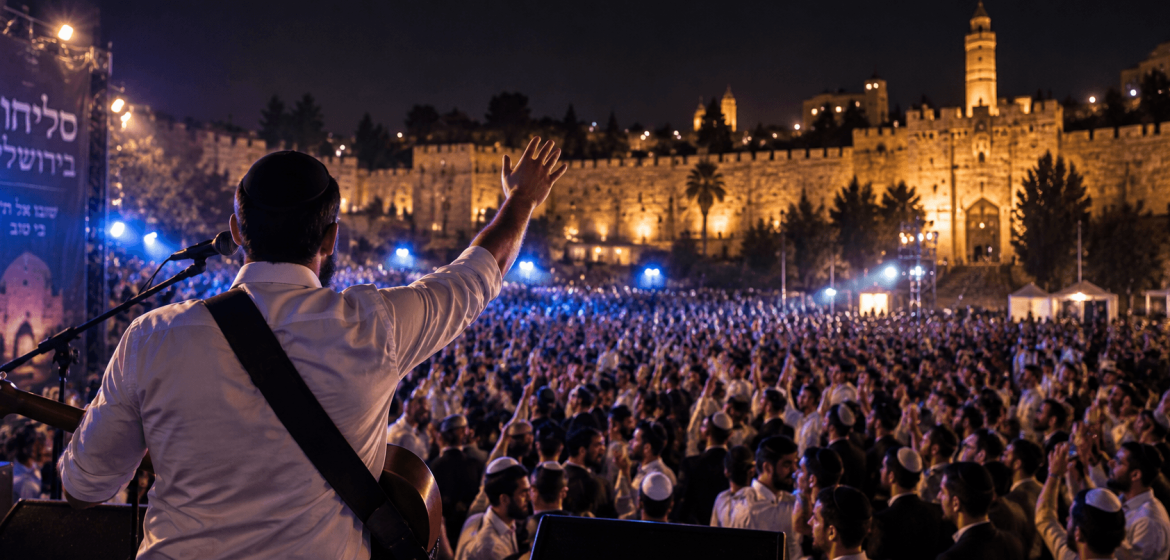

One of the religious arenas to have undergone a dramatic transformation in recent years within Israeli society is that of Selichot and the High Holy Days. Days once identified above all with the synagogue, introspection, repentance, prayer, and confession have increasingly become part of a broad public, popular, and distinctly Israeli culture. Selichot tours fill the streets of Jerusalem, mass Selichot events draw thousands, and the religious music associated with them has penetrated deeply into the wider Israeli cultural sphere.
There is unquestionably an authentic religious search within this phenomenon. It brings people back to the synagogue, to piyyut, to ancestral tradition, and to a language of repentance and closeness to Hashem. Part of the change also reflects a reaction against a particular version of the High Holy Days that became entrenched in parts of the religious world in an excessively one-sided form: days of fear, pain, tears, suffering, intense self-reproach, and relentless introspection. Weariness with this model has generated gentler alternatives, some drawing on Hasidic motifs such as “the King is in the field,” and others reconnecting with another traditional experience of these days, one found more commonly, for example, in Sephardi communities. In many traditions, the High Holy Days were experienced as yamim tovim: days of the joy of mitzvah, spiritual elevation, and intimacy with Hashem. There is considerable justice in the contemporary preference for that picture.
And yet, it seems to me that the change unfolding before us requires a more complex reflection. I want to approach it through one particularly visible aspect: music. Not in order to offer professional musical criticism, but because music can serve as a window onto a much broader question—the character of religious life today, the meaning of repentance, and above all the place of the human being before God.
The conjunction of religion and music may sound strange to some. We are not Christians, and music does not occupy the central place in Jewish worship that it does in church. Yet musicality and musical form have considerable importance for understanding religious experience. Music is not merely a neutral wrapping placed around words whose meaning remains fixed. It shapes the way we hear those words, the temperament in which they are spoken, and the kind of presence we bring to prayer.
The question is therefore not necessarily whether a new melody is inferior to an old one, or whether the atmosphere of prayer may legitimately evolve with the times. The more interesting question is what contemporary music attached to prayer actually does
The question is therefore not necessarily whether a new melody is inferior to an old one, or whether the atmosphere of prayer may legitimately evolve with the times. The more interesting question is what contemporary music attached to prayer actually does. Does it help a person stand before God, or does it turn prayer into yet another arena of experience, self-expression, and emotional release? That is the question I wish to examine.
Popular Selichot[1]
The musical transformation of Selichot takes different forms in Sephardi and Ashkenazi traditions, yet a similar tendency seems to be at work in both.
In Sephardi Selichot, one increasingly encounters melodies and rhythms drawn from pop, contemporary Mizrahi music, trance, club and party music, and stadium songs. The traditional Selichot service, which generally conveyed gravity and restraint, at times takes on a lighter, more “flowing” form. The change lies not only in the origin of the melodies but in the musical language they bring with them: simple and repetitive tunes, an emphasis on the hook, regular four-square rhythms that create a strong sense of melodic predictability and stability, melodic stereotypes, anthem-like motifs, and a reduction of the rubato, improvisation, and richness made possible by the maqam, in favor of lighter and simpler scales. All of this creates a different musical experience. The listener immediately knows where he is, when to join in, and what to sing. That offers an obvious advantage in accessibility, but it may also come at the price of flattening the experience.
These developments are part of a broader attempt to introduce lightness into synagogue music, reshaping prayer into forms perceived as less “heavy.” In many versions, one gets the sense that the aim is almost to “bring Selichot into the club,” allowing people to speak the same musical language in the nightclub and in the synagogue.
The issue is not necessarily the simplicity of the melodies. Some traditional melodies are strikingly simple. Yet a simple melody can deepen a word, open it up, carry it somewhere the word alone struggles to reach. It can also do the opposite: reduce the words to raw material for a simplistic and superficial musical experience.
Alongside the melodic changes, the character of the event itself is changing. The relationship between the prayer leader and the congregation becomes more direct and performative: hand gestures, calls of encouragement, clapping, rhythm, and at times live filming on mobile phones. The cantor becomes, to some degree, a song leader, while the congregation becomes an audience participating in the performance. Communal singing also changes form. Instead of the dialogical structure characteristic of many prayers—cantor and congregation, call and response, listening and answering—we sometimes get mass singing in which everyone acts as a single body. This can generate an extraordinary sense of togetherness, but it is not always the togetherness of a congregation standing before God. At times it is the familiar experience of the concert, the stadium, or the demonstration: the power of the crowd generated through unified rhythm and collective song.
A broader phenomenon of group euphoria is expressed in gestures of casual self-expression, an atmosphere of release and tension relief, and bursts of energy—both in the cantor’s performance and in the bodily gestures of the congregation. These tend to become increasingly conspicuous and extroverted, with clapping, jumping, and dancing entering prayer as routine modes of expression alongside the lighter, bouncier melodies.
A similar development can be observed in the Ashkenazi world. Ashkenazi prayer begins from a different temperament—more piercing in its texts, music, and general atmosphere than many Sephardi traditions, especially certain North African traditions with their softer and more communal character. Yet here too pop culture has entered by way of Carlebach songs, popular “soul” music, and instrumental accompaniment to Selichot.
Carlebach melodies, simple guitar chords, and light “soul” songs may be pleasant at a kumzitz. The problem begins when the logic of the pop performance becomes the logic of prayer: when the prayer leader becomes the conductor of collective catharsis, and when the success of the prayer is measured by the intensity of the crowd’s emotional excitement.
Carlebach melodies, simple guitar chords, and light “soul” songs may be pleasant at a kumzitz. The problem begins when the logic of the pop performance becomes the logic of prayer: when the prayer leader becomes the conductor of collective catharsis, and when the success of the prayer is measured by the intensity of the crowd’s emotional excitement. Catchy, repetitive, closed and symmetrical melodies, designed to produce a collective climax, displace older melodies—deep, winding, or sometimes equally simple but emotionally profound—which led not to catharsis but to devekut.
One can identify similar tendencies in what might be called “popular Breslovism”—and I do not mean Breslov Hasidism itself, which possesses an exceptionally rich world of prayer and song. I mean the popular cultural adoption of certain gestures associated with contemporary Breslov culture: spontaneous dancing, clapping, shouting, jumping, breaking out of order, and even an idealization of silliness and loss of equilibrium. When these become religious ideals in themselves, it is not only the style of prayer that changes, but our understanding of what prayer is.
Not Fear Versus Joy
A clarification is important here. The spirit of the age finds it difficult to tolerate an older model of repentance that turned Elul and the High Holy Days into a season of sadness, crying, suffering, obsessive introspection, and constant fear. And indeed, there is no necessity for these days to take that form. The Book of Nehemiah describes Rosh Hashanah as a day on which the people are told: “Do not mourn and do not weep,” “Eat rich foods and drink sweet beverages,” “for the joy of Hashem is your strength.” Yom Kippur, too, is not meant to be a day of paralyzing, extinguishing terror, but one of purification, holiness, and closeness. A person can return through joy, cry out of love, and confess from a deep sense of intimacy with God.
The more severe model that became especially prominent in parts of the Jewish world, in part through the rise of the Mussar movement, is not the only possible form of repentance. But it does not follow that the alternative is the dismantling of form. The true opposition is not fear versus joy, but lightness versus seriousness; not depression versus ecstasy, but the question of whether the human being understands that he stands before Someone other than himself—before Hashem.
One can rejoice greatly before Hashem. But there is a difference between joy before Hashem and a joy in which Hashem becomes the scenery for a narcissistic experience of the self.
From “the Heart” to a Theology of Experience
The musical transformation is part of a broader change in the contemporary religious landscape. One of its defining characteristics is the elevation of “experience” to the center. Against traditional structures—fixed text, Halacha, discipline, technique, practice, rigor—we repeatedly hear the demand for “heart.” Do not be technical, we are told; what matters is the heart. Do not become entangled in structures and forms; be authentic.
A fixed liturgy teaches a person what to say even where he himself does not yet know how to speak. Tradition is not merely a restriction upon self-expression; at times it is the condition that enables a person to hear a voice that is not his own.
There is much truth in this demand. Prayer without heart can become a dead mechanism. But there is a great distance between that observation and the conclusion that form is meaningless. The human being is not composed of a pure heart on one side and external structures that merely interfere with its expression on the other. Form shapes the heart. Discipline creates sensitivity. A fixed liturgy teaches a person what to say even where he himself does not yet know how to speak. Tradition is not merely a restriction upon self-expression; at times it is the condition that enables a person to hear a voice that is not his own.
The instinctive preference for the “simple heart” over complex structure is also connected to the broader modern ideal of authenticity. Modern culture has rightly granted enormous value to the individual self and to its right to expression. Yet the ideal of authenticity can also become a trap: when everything is measured by the question “What do I feel?”, the self becomes not only the point of departure but also the destination.
From this can emerge a theology of self-affirmation. God becomes the One whose task is to encourage me, soothe me, affirm me, embrace me, and lend meaning to my experience. Religion becomes a place where a person receives another dose of “spirituality,” another measure of comfort, another reinforcement of self-worth. There is nothing wrong with religious consolation. A person truly does need Hashem’s mercy and closeness. But when this becomes the whole story, something essential is lost: the possibility that the encounter with God might change me; that He might not merely tell me that I am good as I am, but demand that I become different from what I am. Prayer, in this sense, is not merely a space for self-expression. It is a space in which the self is put to the test.
The Autonomous Human Being and Dependence on God
Behind this lies a broader tension between modern consciousness and religion. One of modernity’s great achievements is the expansion of the sense of human agency. Man has learned to see himself as responsible for his fate, capable through reason, science, technology, work, and political institutions of changing the world. This is an enormous achievement and, in many respects, a moral one.
But alongside that achievement comes the temptation of absolute autonomy: the fantasy that man is the source of his own power, that he can control every variable, and that ultimately no dimension of existence escapes his management. Religious consciousness introduces a different knowledge into the world. It reminds man that he is created, that he is limited, and that not everything lies within his hands.
This does not demand the erasure of personality or an attitude of helplessness. Jewish tradition is filled with responsibility, initiative, action, and courage. Yet all of these exist within an awareness of limits. Man acts, but he is not God; he bears responsibility, but he does not control the result; he possesses power, but that power does not begin and end in himself. This recognition is especially difficult for a consciousness accustomed to the language of control, self-realization, independence, and empowerment.
Within such a world, religion can easily be pushed into the sphere secular culture has left available to it: therapy for the soul, support for family life, a sense of meaning, belonging, and tranquility. Religion becomes a stabilizing and comforting force within a demanding and chaotic world. Ironically, religious people themselves may adopt this framing. Instead of religion being a destabilizing metaphysical encounter with God, it becomes a mechanism that helps a person function better.
Marx described religion as the opium of the masses. He missed a very great part of the religious phenomenon, but there is certainly such a thing as opiate religiosity—a form of religion whose purpose is to soothe, soften pain, and enable a person to return to his life without anything fundamental having changed.
One of the characteristic features of our time is the preference for a new “spirituality” over mitzvah and form, in the name of the ideal of “heart.” But more deeply than that, religion has in many places become a vehicle for narcissistic self-expression: a space in which a person pats himself on the back, cultivates his ego, and administers repeated injections of encouragement.
Religious dependence is something else. It is not simply a request that God calm me, but the profound recognition that I am not the self-sufficient source of my own existence; that I am incomplete; that I need forgiveness, mercy, and guidance. Not because I am worthless, but precisely because I am human—created, partial, capable of sin, and capable of change. Without recognition of deficiency, there can be no repentance.
One of the characteristic features of our time is the preference for a new “spirituality” over mitzvah and form, in the name of the ideal of “heart.” But more deeply than that, religion has in many places become a vehicle for narcissistic self-expression: a space in which a person pats himself on the back, cultivates his ego, and administers repeated injections of encouragement.
Like other modern phenomena—concerts, mass demonstrations, or the collective atmosphere of sporting events—this new spirituality often constructs itself around the ecstasy of dissolving into the crowd and its collective roar: rhythm, admiration, self-forgetting, and the hypnotic totality of noise.
Prayer as Standing Before God
Here we arrive at the laws of prayer. The Mishnah opens its discussion of the character of prayer with the statement: “One should not stand to pray except in a state of koved rosh”—gravity and seriousness.[2] The decisive word is “stand”: prayer is a ma’amad, a standing before Someone.
The worshipper prepares himself. He arranges his body and clothing, clears his mind, pauses before prayer, and directs his heart. The prohibition against praying while intoxicated reflects the same consciousness: a person incapable of “speaking before the King” is not in a state fit for prayer.[3] These are not arbitrary techniques. The form flows from the question: before whom am I standing?
Prayer is also defined by Chazal as rahamim—a plea for mercy. The human being needs God’s grace. Even as he praises Hashem, he does so out of an awareness of his own limitations: “Even if our mouths were filled with song like the sea, and our tongues with joyous praise like the multitude of its waves… we would still be unable to thank You adequately.”
Dependence upon God also receives bodily expression. The Gemara states:
“A person should not stand in a high place and pray, but should pray in a low place, as it is written, ‘Out of the depths I called You, Hashem’… for there is no haughtiness before the Omnipresent… and one who prays must align his feet, as it is written, ‘and their feet were a straight foot.’”[4]
“There is no haughtiness before the Omnipresent” is a fundamental religious statement. Prayer requires the human being, at least for a time, to leave the center. This does not mean that prayer must be frozen. Jewish tradition contains prayer through song, melody, movement, and even dance. But all of these must unfold within the fundamental framework: a human being stands before Hashem.
This is precisely where questions of style become significant. When clapping, shouting, filming, the movements of the crowd and the cantor, and the constant drive toward a musical climax generate the atmosphere of a performance, we should at least ask whether the ma’amad itself has changed. Am I still praying before the King, or am I very busy experiencing myself praying? This is not merely an aesthetic question. It is a theological one.
The Power of Repentance—and Its Danger
The issue becomes particularly acute with Selichot, because repentance itself is a delicate and paradoxical concept. On the one hand, teshuva proclaims a radical message of freedom: a person can change. He is not chained to his past. Chazal speak even of one who merely contemplates repentance and in a single moment becomes completely righteous.
Precisely because of this extraordinary power, however, there is a danger that repentance will become a mechanism for reducing responsibility. If everything can always be erased, perhaps sin is not so serious; if one can always begin again, perhaps there is no need to take what happened very seriously. Chazal knew this danger well. They therefore said that one who declares, “I will sin and repent, I will sin and repent,” is not afforded the opportunity to repent, and they sharply rejected the conception of Hashem as a vatran, one who simply lets things go.
A person once told me, under the influence of the popularization of Breslov, that someone who is not connected to Rabbi Nachman is “unfortunate”: he has to be afraid of sinning, whereas someone connected to Rabbi Nachman can always go afterward to Uman and be saved. I do not cite this as a description of Rabbi Nachman’s teaching—it is, of course, a gross distortion of it—but as an example of the religious caricature that repentance can produce when separated from responsibility.
Teshuva is not cheap erasure. It is the work of regret, confession, commitment for the future, and change. Forgiveness is possible precisely because the human being is capable of transformation. The manner in which Selichot are recited therefore matters. Selichot are not merely a text informing us that God is merciful; they are supposed to do something to the soul: open it, break something within it, enable confession, and create the possibility of change.
When Selichot become primarily an event of encouragement, empowerment, and release, there is a danger that mercy itself will lose its depth. God forgives me because He is merciful, but the religious question is not only whether He forgives me; the question is whether I return. Mercy that does not invite change quickly becomes self-acceptance, and repentance that changes nothing is not repentance.
Today there is much talk of “self-forgiveness.” Instead of a person confessing his sins and seeking forgiveness, he is far more often encouraged to forgive himself, be less demanding of himself, and stand up for himself—again, as a reaction against the harshness of self-flagellation. Yet self-forgiveness can place human pride at the center and express an unwillingness to stand before Hashem with modesty, humility, regret, and confession. Repentance thereby loses its original meaning and becomes a generic exercise in encouragement—much like the new music that accompanies it.
Selichot Tours and Selichot Performances
Against this background, we should also consider the fashion for Selichot tours and performances, which in recent years has become an enormous Israeli phenomenon, particularly in Jerusalem. As noted, my intention is not to denounce the phenomenon. It contains much that is precious. People with no regular relationship to the synagogue encounter piyyut, liturgy, tradition, and Jewish memory; sometimes such an encounter opens a genuine door to closeness with Hashem and to repentance. The meeting of sacred and secular is not inherently objectionable. At times this is precisely how a living tradition reaches a broader public.
In some places Selichot become a kind of religious carnival: a night out, a date, a social excursion, one stop on an itinerary of food, music, and atmosphere. At times the event even contains behaviors that are the very opposite of repentance—verbal aggression, vulgarity, or dancing around slogans of hatred.
Yet precisely because the phenomenon is so important, it deserves serious criticism. In some places Selichot become a kind of religious carnival: a night out, a date, a social excursion, one stop on an itinerary of food, music, and atmosphere. At times the event even contains behaviors that are the very opposite of repentance—verbal aggression, vulgarity, or dancing around slogans of hatred. This is very far from the traditional image of young and old rising before dawn in order to move their hearts toward repentance.
The challenge is not to prevent people from coming. Quite the opposite. We need to think about how to turn this initial encounter into a gateway. Kiruv is not exhausted by placing a religious label upon an existing form of entertainment. If we want to bring a person closer to prayer, we must also teach him how to pray: introduce him to a world in which there is a text worth listening to, a melody worth lingering within, a silence that has value, and a mode of standing in which the human being is not the center of the event. Closeness requires both content and form.
Restoring Seriousness, Not Fear
This brings us back to where we began. It may well be that people today are no longer prepared for a religiosity of fear and depression, and I am not certain we should regret that. Repentance can and should contain joy, hope, closeness, and mercy. Prayer can be profoundly musical, warm, and even sweeping. But joy is not lightness; closeness is not the abolition of distance; and Hashem’s mercy does not mean that human actions cease to matter.
The alternative to fear is not religious nihilism, and the alternative to oppressive heaviness is not performance. Perhaps the religious task of our time is precisely to rediscover the possibility of joy that contains koved rosh: the joy of mitzvah, the joy of one who knows that he stands before Hashem, a joy that does not abolish repentance but makes it possible.
Music matters enormously here. It can take us beyond ourselves, open within us a space for listening, and create an intimacy that is not narcissistic. It can also turn us into a crowd absorbed in experiencing itself. The test is not whether the melody is old or new, Sephardi or Ashkenazi, Hasidic or popular. The test is what it teaches us to do: whether it teaches us only to feel—or also to stand.
Selichot are a plea for mercy, but mercy is not opium. They are closeness, but closeness to One who exists beyond us. They are music, but music that seeks to move the human being toward repentance. Ultimately, perhaps this is the delicate art we need to restore to prayer: not the old fear but seriousness; not depression but humility; not less joy, but a joy that knows before Whom it rejoices.
To stand before Hashem—and to rejoice in doing so.
[1] In this connection, and more broadly with regard to the subject of this article, I refer the reader to the important essay by Rabbi Prof. Yosef Yitzhak Lifshitz, “To Hear the Song and the Prayer,” Akdamot 21. In a similar spirit, see Rabbi Prof. Lifshitz’s article published in this forum, “On the Erosion of the Musical Tradition of Prayer,” Tzarich Iyun, https://iyun.org.il/en/sedersheni/the-contemporary-eclipse-of-nusach/.
[2] Mishnah Berachot 5:1.
[3] Mishnah Berakchot 5:1; see the discussions in Berakhot 30–32. Regarding one who has been drinking or is intoxicated, see Eruvin 64a and the laws of prayer.
[4] Berachot 10b.


I like the old Ashkenazi nusach tunes much better than nearly all religio-pop numbers. The latter can be intrusions that do not produce the right mood. When new tunes are poorly matched to text, either in mood or in the number of syllables, I recoil. Likewise on Yamim Noraim.